Huge crowds fill Tehran streets for Khamenei’s funeral procession
Huge crowds fill Tehran streets for Khamenei’s funeral procession
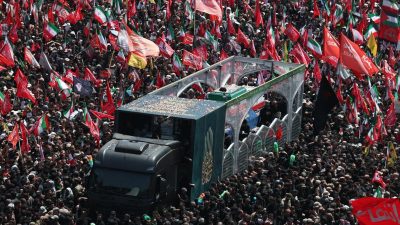
Constantvpn.com – Tens of thousands of Iranians gathered in the capital on Monday to mourn the passing of Ayatollah Ali Khamenei, the supreme leader who was killed on the first day of the war with the US and Israel. The event, which unfolded with solemnity and fervor, showcased the nation’s collective grief and solidarity, as reported by Iranian state media. Khamenei’s body, draped in a black flag, was transported by a lorry through a 10km route that passed by Enghelab Square, one of Tehran’s most iconic landmarks. The procession, part of three consecutive days of public mourning, concluded at the Grand Mosalla mosque where Khamenei’s remains lay in state for two days prior.
A Symbol of National Mourning
Massive throngs filled the main avenues of Tehran, creating a sea of red banners and Iranian flags that symbolized the country’s resolve for vengeance. The crowd’s chants echoed through the streets, with many repeating the slogan, “The US killed our father. We won’t let you go!” as they waved banners and gathered around the lorry carrying Khamenei’s coffin. Placards displayed messages such as “We must rise” and “Death to Trump,” referencing the joint attack on Iran four months ago that targeted Khamenei’s home and led to the loss of his wife and two of his sons. One mourners’ act of defiance stood out: throwing stones at a billboard of US President Donald Trump’s face, which was hung from a bridge, as a sign of their anger toward the perceived enemy.
“Any Iranian leader who will again try to pursue plans to destroy Israel will be killed as well,” stated Israel Katz, the Israeli Defence Minister, during a press briefing.
The emotional weight of the event was further underscored by the absence of Mojtaba Khamenei, the son who assumed the role of supreme leader after his father’s death. Mojtaba, who was seriously wounded in the same Israeli air strike that claimed his father and wife on 28 February, remained hidden from public view, adding to the sense of mourning and uncertainty. Meanwhile, former president Mahmoud Ahmadinejad made his first major public appearance since the war began, reportedly accompanying the funeral procession. His presence, along with current president Masoud Pezeshkian, who walked among mourners on a Tehran street, highlighted the transition of leadership and the unity of the nation in remembrance.
Legacy and Future Steps
Ali Khamenei, who led Iran for 37 years, is remembered as a figure who embodied the country’s revolutionary spirit. His death marked the end of an era, with his sons’ participation in the funeral rituals signaling both continuity and change. State media emphasized the significance of the event, framing it as a moment of national reflection and renewed determination. The ceremonies also included a call to uphold Iran’s “honor, progress, and glory,” as Pezeshkian reiterated in a post on X, echoing Khamenei’s teachings about the people’s unity being Iran’s greatest strength.
Amid the mourning, the broader geopolitical context emerged. The funeral processions took place just weeks after Iran and the US reached a preliminary agreement to end the war and restore the Strait of Hormuz, a vital waterway for 20% of global oil and gas shipments. Both nations pledged to finalize a deal within two months, addressing Iran’s nuclear program, US sanctions, and the pursuit of a permanent truce. However, the events surrounding Khamenei’s death have complicated this progress, with Israel’s involvement in the strike that killed him casting a shadow over the talks. Qatar, acting as a mediator, noted “positive progress” in indirect negotiations held in Doha, though tensions remain high.
A Path Forward or a Return to Conflict?
The funeral ceremonies are set to continue in Qom, a central hub for Iran’s Shia Muslim clerical establishment, on Tuesday. From there, the mourning will extend to the Iraqi shrine cities of Karbala and Najaf on Wednesday, before culminating in Khamenei’s burial at the Imam Reza shrine in Mashhad, his hometown in northeastern Iran. This final act of tribute underscores the deep-rooted religious and cultural significance of the event, as well as the nationalistic fervor that has defined the war’s aftermath.
While the procession emphasized unity and resilience, it also highlighted the fractures within Iran’s leadership. Mojtaba’s absence, though not confirmed as a political statement, has sparked speculation about his role in the country’s future direction. As the nation processes its loss, the question remains: will the funeral’s symbolism translate into a lasting peace, or will it fuel further conflict? The answer may lie in the coming days, as officials navigate the delicate balance between mourning and military strategy.
Despite the mourning, the funeral also served as a platform for rallying support against external adversaries. The red banners, often associated with revolutionary ideals, and the anti-US rhetoric in the crowd’s messages reinforced the narrative of Iran as a unified front against Western powers. This sentiment was particularly strong among those who viewed the strike as a direct attack on Iran’s sovereignty, a belief that has driven much of the country’s recent actions.
As the funeral concluded, the focus shifted to the next phase of events. The procession in Tehran was followed by a series of prayers in Qom, a city steeped in religious and political history. The mourning will then travel to Karbala and Najaf, cities revered by Shia Muslims, before ending in Mashhad. These locations, chosen for their symbolic importance, reflect the deep connection between Iran’s leadership and its cultural heritage. The final burial at the Imam Reza shrine, a site of pilgrimage, is expected to draw even larger crowds, further cementing Khamenei’s legacy in the hearts of Iranians.
While the funeral has united the nation in grief, it also serves as a reminder of the war’s toll. Thousands of lives were lost in the four-month exchange of strikes, and the attack on Khamenei’s home marked a pivotal moment. Yet, the procession’s imagery—of a nation standing together, flags waving, and voices echoing with resolve—suggests that Iran remains steadfast in its pursuit of justice and national pride. Whether this will lead to a permanent truce or a continuation of hostilities remains to be seen, but for now, the focus is on honoring a leader whose vision shaped the country’s course for decades.
