
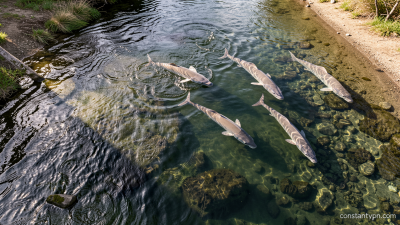
Whales Flood Into East Greenland’s Thawing Seas
Constantvpn.com – For centuries, a wall of sea ice kept the largest animals on Earth locked out of East Greenland’s coastal waters. That barrier is now crumbling. Over the past two decades, researchers have documented a sweeping ecological transformation along this Arctic coastline: humpback, fin, and minke whales — species that historically never appeared in these waters — are arriving in growing numbers each summer to feed in what was once an ice-bound exclusion zone.
The shift is not subtle. It represents what one lead scientist has termed a fundamental reorganization of the marine environment, driven by warming ocean temperatures and the retreat of seasonal ice cover. What was once a frozen frontier has become, for several months of the year, an open feeding ground accessible to some of the planet’s most massive animals.
A Decade-by-Decade Record of Change
The scale of the transformation becomes stark when viewed through the lens of long-term observation data. Ship-based surveys conducted in the region failed to record a single humpback whale sighting before 2006. The following year, seven individuals were logged. By 2024, the tally had surged to 150 ship-based sightings of humpbacks alone — a jump from zero to three figures in roughly two decades.
To capture a fuller picture, researchers conducted the first systematic aerial surveys of baleen whales — the filter-feeding group encompassing fin, minke, and humpback species — off the East Greenland coast during the summers of 2015 and 2024. Those flights were supplemented by data from 15 whales fitted with satellite tracking devices, which allowed scientists to follow individual animals’ seasonal migrations. Testimony from Inuit hunters, whose generations of coastal observation provide an irreplaceable long-term record, was also woven into the analysis.
The combined dataset revealed that an estimated 4,000 humpback whales, 6,000 fin whales, and 6,000 minke whales entered the Greenland Sea during the summer of 2024. Researchers calculated that these three species together would consume at least 800,000 tonnes of fish and krill over a single summer feeding season — a figure that underscores just how much biomass is now flowing through these waters.
What the Scientists Are Saying
Prof Mads Peter Heide-Jørgensen, based at the Greenland Institute of Natural Resources, described the magnitude of change in blunt terms:
“Probably the most radical we can see anywhere in the subarctic.”
He characterized the phenomenon as a “major ecological regime shift” — a phrase that signals not a gradual drift but a categorical change in how the marine ecosystem functions along this stretch of coast. The whales, he noted, appear to be feeding on fish populations that themselves have migrated into the warming waters of East Greenland, creating a cascade of ecological redistribution.
On whether climate change is uniformly harmful for marine life, Heide-Jørgensen offered a more nuanced framing:
“For some species, climate change is not necessarily a problem — it opens up new opportunities, but other species are losing their habitat.”
Winners and Losers in a Rewiring Arctic
The baleen whales arriving in East Greenland are, in effect, opportunistic generalists. Their large body size, broad dietary flexibility, and migratory range allow them to exploit newly available feeding grounds with relative ease. Yet the same warming that opens these waters is closing others.
Arctic specialists such as narwhals and beluga whales — species adapted to cold, ice-associated environments — are finding their traditional habitat compressed or eliminated. Heide-Jørgensen described these animals as being “in trouble now,” sharing space with, or in some cases being displaced by, the influx of larger baleen whales. The competitive and spatial pressures of this overlap remain an active area of study.
Redistribution or True Growth?
An important question the study does not fully resolve is whether the growing whale presence in East Greenland reflects a genuine increase in the total populations of these species, or simply a geographic redistribution from other feeding areas — particularly West Greenland. Several independent experts noted that the data are consistent with animals shifting eastward from western waters rather than with a population boom. This distinction matters in a country like Greenland, where certain whale species are subject to subsistence and commercial hunting, and where shifts in distribution can carry direct implications for local communities and management policy.
The scientists emphasized that their findings nonetheless point to genuine adaptive behavior: these “opportunistic” baleen whales appear to be adjusting their seasonal ranges in response to changing conditions, and may be deriving net benefit from the altered environment.
Broader Context and Publication
The research, spanning multiple decades of fieldwork, aerial survey, satellite telemetry, and Indigenous knowledge, was published in the peer-reviewed journal Frontiers in Marine Science. It adds to a growing body of evidence that the Arctic marine ecosystem is being restructured at a pace that outstrips many existing management frameworks. As sea-ice extent continues to decline and ocean temperatures climb, the question for policymakers and conservation planners is no longer whether these shifts will occur, but how quickly adjacent species, fisheries, and Indigenous livelihoods will be affected by the cascading consequences.
Related Reading
Frequently Asked Questions
What is Giant whales move into Greenland waters?
Giant whales move into Greenland waters is the main topic of this guide. The article explains the context, practical details, and next steps readers should understand.
Why does Giant whales move into Greenland waters matter?
Giant whales move into Greenland waters matters because readers are looking for a useful answer, not just a short summary. Good content should match search intent and help them decide what to do next.