
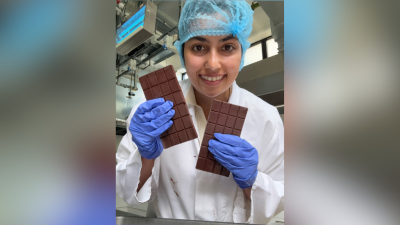
University of Reading Student Crafts Historic British Chocolate Bar
Constantvpn.com – A remarkable achievement in British agriculture has been realized at the University of Reading, where Maha Khan, a master’s student specializing in food security, has produced what may be the nation’s first entirely homegrown chocolate bar in nearly ninety years. The creation, appropriately titled the Reading 100 Chocolate Bar, celebrates both the university’s centenary and a century of British chocolate-making heritage.
What makes this accomplishment particularly noteworthy is the origin of its primary ingredient. Rather than relying on cocoa beans imported from tropical regions such as Brazil or Bali, this confection features cocoa cultivated right here in Berkshire. The beans were harvested from the university’s International Cocoa Quarantine Centre, a sophisticated facility housing over three hundred distinct varieties of cocoa plants.
A Century of British Chocolate
The significance of this achievement extends far beyond a simple agricultural milestone. The last time such a chocolate bar was produced in Britain dates back to 1932, when the confectionery company Rowntree’s presented a six-year-old Princess Elizabeth with what remains the only other UK-grown chocolate bar ever created. Khan’s accomplishment bridges almost a century of British chocolate history, demonstrating that domestic cocoa cultivation is not merely possible but viable.
The production process itself was meticulous and labor-intensive. Khan harvested the cocoa pods directly from the quarantine centre, carefully removed the surrounding pulp to extract the beans, and then initiated a fermentation period lasting between seven and ten days. Following fermentation, the beans were laid out to dry in the sun—a process facilitated by particularly favorable British weather conditions. The subsequent stages involved drying, roasting, and then utilizing university laboratory facilities to winnow, grind, and crush the beans before blending them with milk and sugar to create the final product.
Climate Challenges and Global Supply
While the achievement of creating 100% British chocolate is remarkable, Khan emphasized that her work serves a broader purpose: highlighting the vulnerabilities facing the global cocoa industry. Speaking to the Today programme, she noted that despite our ability to produce domestic chocolate, the sector faces mounting pressures.
It is incredible that we can make 100% British chocolate – but in the context of climate change, pests and diseases, there are estimates that 30 to 40% is lost.
She further explained that recent heatwaves and other climate-related phenomena suggest these challenges will only intensify in coming years. The UK’s chocolate market, valued at an impressive £10.4 billion, currently depends entirely on imported cocoa, making it particularly susceptible to disruptions in global supply chains.
The Quarantine Centre’s Global Role
The International Cocoa Quarantine Centre plays a crucial role in maintaining global cocoa health. Located in Berkshire, this climate-controlled facility is carefully managed to prevent the transmission of pests and diseases between different cocoa-growing regions worldwide. According to Khan, the centre serves as the primary transfer hub for 97% of cocoa-growing nations, with each plant undergoing a two-year quarantine period before being released for cultivation.
I harvested the cocoa from the quarantine centre, removed the pulp, the beans, fermented it, which takes about seven to 10 days, then I laid it out in the sun, because we’ve had glorious weather, that helped dry it.
Khan expressed her desire to draw attention to this important research facility, noting that many people remain unaware of its existence and significance. The centre not only protects global cocoa supplies but also provides scientists with valuable opportunities to study these plants under controlled conditions.
Local Production and Global Trade
Prof Carol Wagstaff, director of AgriFood Futures at the University of Reading, provided additional perspective on the broader implications of this achievement. She noted that the UK chocolate industry relies on a supply chain originating thousands of miles away in the tropical regions of Africa, South America, and Asia.
The UK chocolate industry rests on a supply chain that starts thousands of miles away in the tropics of Africa, South America and Asia.
Wagstaff emphasized that a resilient global market is essential for the smallholder farmers who form the backbone of the industry. These farmers, she explained, often operate in regions most vulnerable to climate change risks, making them particularly dependent on stable international trade relationships.
While growing and buying local produce often makes sense for your health, and helps the economy and environment, it is not a universal rule. International trade in food can be a good thing, providing economic stability for communities whilst using natural energy resources for production, and we need to invest in research to keep threats at bay.
The Reading 100 Chocolate Bar thus represents more than a local agricultural success story. It stands as a testament to the importance of research, international cooperation, and investment in understanding how to maintain food security in an increasingly uncertain climate future. As the world grapples with changing weather patterns and growing populations, projects like this demonstrate that innovation and local production can complement rather than replace global trade networks.
Related Reading
Frequently Asked Questions
What is First 100 British chocolate bar made?
First 100 British chocolate bar made is the main topic of this guide. The article explains the context, practical details, and next steps readers should understand.
Why does First 100 British chocolate bar made matter?
First 100 British chocolate bar made matters because readers are looking for a useful answer, not just a short summary. Good content should match search intent and help them decide what to do next.