
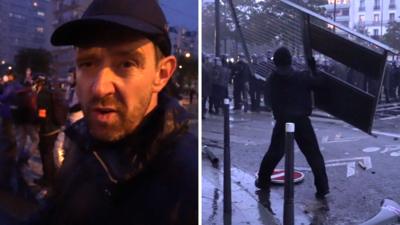
Paris Protests Escalate After Dark as Police Use Tear Gas and Water Cannons
Constantvpn.com – Clashes broke out in Paris on Saturday night after a day of demonstrations that had been largely peaceful in many areas of France. As darkness fell, groups of protesters threw objects and fireworks towards riot police, prompting officers to respond with tear gas and water cannons.
The violence marked a sharp change in atmosphere from earlier in the day, when large crowds gathered across the country. French authorities deployed about 70,000 police officers nationwide for the second weekend in a row, underlining the scale of the security operation surrounding the demonstrations.
Large Turnout and Widespread Security Operation
The Interior Ministry put participation in Saturday’s protests at around 400,000 people. Nearly 1,000 arrests were made during the day, reflecting the tense conditions that developed in several locations as the evening progressed.
Paris became one of the most closely watched centres of unrest. Demonstrators and police faced each other in the streets, with fireworks and other projectiles used by some members of the crowd. Officers sought to clear and disperse groups using crowd-control measures, including tear gas and water cannons.
Such tactics are intended to create distance between police lines and crowds when officials believe public order is at risk. Their use can also intensify an already volatile situation, particularly when large numbers of people remain gathered after an organised march or demonstration has ended.
A Peaceful Day Gives Way to Disorder
Saturday’s events showed how quickly a major demonstration can shift after nightfall. Most participants took part without violence during the daytime protests, but disorder later emerged as some people confronted police officers in Paris.
The distinction is significant: mass protests can include people with very different aims and approaches. Many attend to express a political or social view, while a smaller number may become involved in confrontations that change the character of an event and draw a heavy police response.
The scale of the arrests, alongside the nationwide deployment, suggests authorities were preparing for the possibility that unrest could return after the previous weekend. A second consecutive major police mobilisation also places pressure on emergency services, transport networks and city-centre businesses, particularly where streets are closed or crowds are directed away from key areas.
Why the Situation Matters Beyond Paris
Although the most dramatic scenes unfolded in the French capital, the demonstrations were national in scope. The turnout estimate of 400,000 indicates that the unrest cannot be understood solely as a Paris issue. Events in the capital often attract the greatest attention because of the city’s symbolic role and dense urban setting, but the wider protest movement has reached communities across France.
For residents and visitors, a large security presence can mean delays, restricted access to public spaces and sudden changes to travel plans. Tear gas and water-cannon operations can also affect people who are not directly involved in confrontations, especially when crowds are moving rapidly through central streets.
The immediate challenge for officials is maintaining public safety while allowing peaceful assembly to continue. For protesters, the night-time violence risks overshadowing the concerns that brought many people onto the streets in the first place. Once clashes dominate public attention, debate can become focused on security and policing rather than the issues behind the demonstrations.
No Immediate Sign of Calm Returning
Europe correspondent Nick Beake, reporting from Paris, said there were few indications that the unrest would ease in the near future. That assessment points to the likelihood that authorities will continue to treat further demonstrations as high-risk events and retain substantial police resources.
The coming days will be closely watched for signs of whether tensions fall or whether confrontations recur. The number of officers deployed, the use of crowd-control equipment and the high arrest total all show that Saturday’s protests developed into one of the most serious public-order challenges facing France in recent weeks.
For now, the images from Paris capture a divided evening: large-scale public protest on one side, and escalating confrontation between a smaller group of demonstrators and riot police on the other. Whether future gatherings remain peaceful may depend on whether both sides can prevent the kind of night-time disorder seen on Saturday from taking hold again.
Related Reading
Frequently Asked Questions
What is Fireworks and tear gas as protesters?
Fireworks and tear gas as protesters is the main topic of this guide. The article explains the context, practical details, and next steps readers should understand.
Why does Fireworks and tear gas as protesters matter?
Fireworks and tear gas as protesters matters because readers are looking for a useful answer, not just a short summary. Good content should match search intent and help them decide what to do next.