
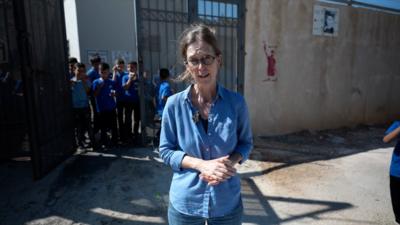
Barbed Wire Now Rings a West Bank School as Families Brace for Another Season of Violence
Constantvpn.com – Parents in a small Palestinian village north-east of Ramallah have watched their children walk to class past coils of razor-sharp fencing, a physical reminder that the threat of settler gunfire has moved from the margins of daily life into the schoolyard itself. In al-Mughayyir, a community of a few thousand residents nestled in the hills of the occupied West Bank, barbed-wire barriers have been erected around the local school as families seek whatever measure of protection they can muster against a wave of attacks that has claimed six lives this year alone.
A Village Encircled by Outposts
Al-Mughayyir sits in a geographic position that has made it a flashpoint for decades. Jewish settler outposts have multiplied around the village, many of them small, informal structures that appeared without planning permits or formal government sanction. Israeli military units maintain a regular presence at the village entrance, where an improvised checkpoint is set up with little advance notice, halting residents and visitors who simply wish to travel to or from their homes. For families with school-age children, the daily commute to class now threads a corridor of military vehicles, checkpoint barriers, and the ever-present possibility of confrontation.
The encirclement is not merely symbolic. Each outpost narrows the space in which villagers can move freely, and the cumulative effect is a community that feels hemmed in from every direction. Teachers and parents describe a climate of anxiety that has seeped into the classroom: children arrive with stories of what they saw on the road, and lessons are interrupted by the sound of vehicles or, on worse days, by gunfire.
Six Deaths, Three of Them Children
The toll this year has been brutal and specific. Six residents of al-Mughayyir have been killed in incidents linked to settler violence, and three of the six were pupils attending the very school now ringed with wire. Among the dead is 14-year-old Aws al-Naasan, who was shot by a settler outside the school gates in April. His killing, like several others in the region, occurred within sight of the building where dozens of his classmates sit each morning, turning the walk to class into a route that families now measure in fear as much as in minutes.
The pattern of these killings — young people struck near their homes, near their schools, near the roads they have walked since childhood — has deepened a sense among residents that no routine activity is safe. Parents who once walked their children to the gate now linger at the perimeter, watching for movement, listening for the crack of a rifle before it reaches their ears.
The Legal Landscape
Under international law, all Israeli settlements in the occupied West Bank are considered illegal. This position, affirmed by successive United Nations General Assembly resolutions and by the International Court of Justice, rests on the principle that a occupying power may not transfer its own civilian population into territory it administers. The broader settlement enterprise, therefore, operates in a state of legal contestation that has persisted for more than half a century.
Within Israel’s own domestic legal framework, the situation around al-Mughayyir is even more tenuous. Many of the small ad-hoc outposts that have sprouted in the village’s vicinity were built without planning approval and without formal land titles. They exist in a grey zone: tolerated by the authorities, occasionally demolished by court order, and then rebuilt. For the villagers who live beside them, the distinction between “illegal under Israeli law” and “illegal under international law” offers little comfort. The wire is still there. The checkpoint still opens and closes at the soldiers’ discretion.
What the Fencing Signals
The decision to fence a school with barbed wire is not a routine infrastructure upgrade. In a context where the primary threat is not weather or structural decay but armed individuals operating outside the school’s walls, the wire functions as both a physical barrier and a psychological statement: the community has concluded that ordinary precautions are no longer sufficient. It is a measure that parents, teachers, and local leaders adopted because they could find no institutional guarantee that their children would reach the classroom unharmed.
The broader implication is one of eroding trust in the security architecture that is supposed to protect civilians on both sides of the divide. When a school must bolt itself shut against its neighbours, the question shifts from “how do we prevent the next shooting?” to “what kind of daily life remains possible in a place where the boundary between home and danger has become porous?”
For now, the children of al-Mughayyir walk past the wire each morning. Their parents watch from a distance, counting heads, waiting for the bell. The fencing holds. The question it cannot answer is how long it will need to.
Related Reading
Frequently Asked Questions
What is Fears for children s safety in West?
Fears for children s safety in West is the main topic of this guide. The article explains the context, practical details, and next steps readers should understand.
Why does Fears for children s safety in West matter?
Fears for children s safety in West matters because readers are looking for a useful answer, not just a short summary. Good content should match search intent and help them decide what to do next.