
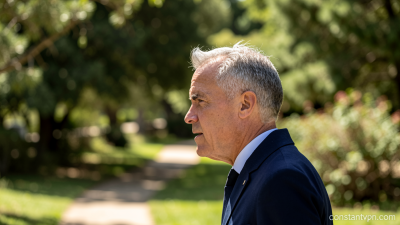
Canada’s Prime Minister Bets the Nation’s Economy on a Trade Standoff
Constantvpn.com – For decades, the North American trading relationship operated on an unspoken assumption: that Washington and Ottawa would always find a way back to the table. That assumption has now been shattered. Prime Minister Mark Carney made the late-night call to suspend negotiations with President Donald Trump and pivot toward retaliatory tariffs, effectively ending what had appeared, for roughly a week, to be a near-finalized commercial agreement between the two countries. The move places Carney among the very first heads of government to walk away from a deal with the White House that seemed within arm’s reach — a decision whose political consequences will be scrutinized on both sides of the border for months to come.
The Final Hours: Who Broke What
By all available accounts, the collapse came down to the wire. Carney described the last-minute American proposals as “unfair, uneconomic, and called into question the reliability of any deal,” specifying that they included fresh demands targeting the automobile sector alongside what he termed “unacceptable” restrictions on Canada’s ability to strike trade agreements with other nations. In a pointed remark aimed squarely at the Trump administration, he added:
“We recognise sometimes its signature is written in pencil.”
The White House side told a different story. US Trade Representative Jamieson Greer attributed the breakdown to “new demands and walk backs of other commitments by Canada,” framing the impasse as Ottawa’s own doing. Carney, for his part, characterized the American posture as a “power play” built around eleventh-hour revisions, and accused Washington of having “asked too much” while “offering too little.”
A War by Another Name
Pressed by a reporter on whether the two countries were now locked in a trade war, Carney did not mince words:
“You’re at war when you’re attacked — we got attacked.”
Switching to French in the same briefing, he framed the spiralling dispute as something imposed on Canada rather than chosen by it, before delivering a rallying line aimed at domestic audiences:
“Canada is strong, Canada is ready, Canada is united.”
The rhetoric matters because the economic stakes are enormous. Roughly seventy percent of Canadian exports flow into the United States, making the country far more exposed to American tariff policy than most of its peers. On the American side, Canada remains the top trading partner for several states, with Michigan, Kentucky, Indiana, and Ohio sitting at the front line of any escalation. A prolonged standoff would therefore inflict measurable pain on manufacturers, farmers, and service providers in both economies.
The Domestic Calculus
Carney arrived in office riding a campaign slogan borrowed from ice hockey — “elbows up” — a phrase signaling an aggressive, no-nonsense posture toward a Trump administration intent on leveraging economic pressure to advance its America First agenda. That posture now faces its most consequential test. Convincing Canadians that short-term economic pain is a worthwhile price for preserving long-term negotiating leverage will require sustained public communication, especially as counter-tariffs and American duties compound pressure on businesses and consumers simultaneously.
Opinion data suggests the prime minister has room to maneuver, though not unlimited latitude. An Abacus Data survey found approximately thirty-six percent of Canadians supportive of retaliating against US tariffs, while a Leger poll showed fifty-six percent wanting the federal government to hold a hard line and make no further concessions. Those figures indicate a substantial bloc willing to absorb economic friction in exchange for perceived dignity at the negotiating table, but they also leave a meaningful minority that may grow impatient if the pain outlasts the political narrative.
Boycotts and the Consumer Front
Grassroots frustration has already translated into measurable economic disruption. Canadian consumers have increasingly chosen to skip US travel, costing American destinations an estimated C$3.3 billion (roughly $2.35 billion or £1.75 billion) in lost tourism revenue over the past year. Provincial governments have compounded the pressure by pulling American alcoholic beverages from retail shelves. US wine exports to Canada dropped seventy-eight percent year over year — a $357 million loss in export value — while the US distillers association reported that provincial bans have driven American spirits exports down by more than seventy percent. The alcohol sector quickly became a flashpoint that the Trump administration found difficult to dismiss.
Provincial Unity — For Now
Carney also faces the task of keeping Canada’s provinces aligned, particularly those whose economies have been less directly exposed to the tariff dispute. He briefed premiers on Saturday about the state of negotiations, and the immediate response was one of solidarity. British Columbia Premier David Eby pledged commitment to what he called the “national project we are on.” Ontario Premier Doug Ford took a more combative tone:
“We didn’t start this fight but I can assure you, we’re going to win this fight.”
That unity, however, is provisional. Provinces whose export baskets lean less heavily on the US market may grow restless if the standoff drags on without visible progress toward a better agreement. Carney’s ability to convert short-term provincial solidarity into durable political capital will depend on whether he can demonstrate, within a defined timeframe, that the walkaway produced a superior deal rather than merely a more expensive one.
What Comes Next
With talks suspended and retaliatory tariffs in motion, both governments now operate without a clear off-ramp. The next phase will be defined less by formal negotiation and more by the accumulation of economic costs on either side — costs that will test public patience in Ottawa, in Detroit, in Louisville, and in every community that depends on cross-border supply chains. Carney’s gamble is that Canada can endure the pressure long enough to force Washington back to terms it finds acceptable. Whether that calculus holds will become apparent not in press conferences, but in the quarterly earnings reports of the manufacturers and exporters caught in the crossfire.
Related Reading
Frequently Asked Questions
What is Carney faces crucial test after walking?
Carney faces crucial test after walking is the main topic of this guide. The article explains the context, practical details, and next steps readers should understand.
Why does Carney faces crucial test after walking matter?
Carney faces crucial test after walking matters because readers are looking for a useful answer, not just a short summary. Good content should match search intent and help them decide what to do next.