
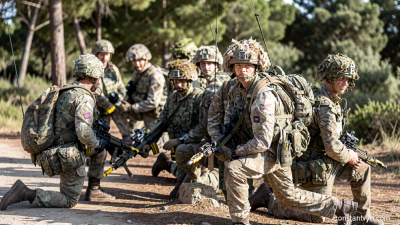
UK Army Training Budget Squeezed as Defence Spending Debate Intensifies
Constantvpn.com – British soldiers stationed at home bases will face a significant reduction in collective training activities this year, as the Ministry of Defence redirects limited funds toward capital investment programmes. Units based in the United Kingdom that are not in the process of preparing for an overseas posting have received instructions to scale back large-scale exercises, a move driven by acute pressure on the training budget rather than any operational decision by the Army itself.
The restriction does not apply across the board. Formations currently preparing for deployment — including battalions rotating to Estonia, the Falkland Islands, or Cyprus — will maintain their full training schedules. What is being curtailed is what one defence insider described as “nice to have training”: the kind of large-scale live-fire drills and rehearsed platoon assaults that would normally take place on ranges such as Salisbury Plain in Wiltshire or Sennybridge in Wales.
What Has Been Cancelled
Among the exercises already scrubbed from the calendar is a Royal Tank Regiment live-fire programme scheduled for Wales, alongside a combined-arms rehearsal involving main battle tanks and Apache attack helicopters. The pause on these activities is expected to persist through the majority of the current year.
Crucially, the Army has signalled that modernisation-focused training will not be sacrificed. Practises centred on drone operations and counter-drone warfare — capabilities sharpened by lessons drawn from the ongoing conflict in Ukraine — are expected to proceed as planned. Each individual training request is now being assessed on a case-by-case basis, with priority given to activities that most directly enhance combat readiness.
“Our training continues and we are prioritising activity that contributes most directly to readiness, deployability and operational effectiveness. We are also investing £2bn to transform training for the British Army over the next 15 years.”
— Army spokesperson
The Broader Fiscal Picture
The training cuts arrive at a moment of heightened political scrutiny over how much the state should allocate to its armed forces. The government has committed to raising defence expenditure to 2.5 per cent of national income by next year, yet mounting pressure — from within the coalition’s own ranks and from opposition parties alike — pushes toward a target of 3 per cent of GDP by the close of the decade.
The complication is that much of the incremental funding has already been ring-fenced for specific capital projects, notably new weapons acquisition programmes. The recurring training line, by contrast, remains under severe strain. In effect, the MoD is being asked to fund both ambitious procurement and sustained operational readiness from a budget that has not yet absorbed the full cost of either.
Political Fallout and Opposition Criticism
The issue dominated Prime Minister’s Questions on Wednesday, when Tan Singh Dhesi, Labour’s chairman of the Commons Defence Select Committee, pressed Prime Minister Andy Burnham to commit publicly to the 3 per cent threshold by 2030. Burnham responded that he had already made that pledge “very clear” and had maintained it “for a considerable period of time.”
“I’ve made that commitment very clear, and I have done for a considerable period of time.”
The exchange lands against a backdrop of recent turbulence. The previous administration under Sir Keir Starmer saw its defence funding plans contribute to political instability, culminating in the resignation of Defence Secretary John Healey over disagreements about how to resource the armed forces. The current government’s Defence Investment Plan (DIP) charts spending rising to 2.7 per cent of GDP by the 2027/28 fiscal year, but offers no firm mechanism for reaching higher levels beyond that date. The Treasury has indicated that concrete plans for both the 3 per cent and 3.5 per cent milestones will be tabled at next year’s spending review.
From the opposition benches, Conservative leader Kemi Badenoch has called on Burnham to redirect welfare expenditure toward defence, arguing the party would allocate 3 per cent of GDP to the military by 2030. Shadow work and pensions secretary Helen Whately framed the choice in stark terms:
“Faced with a choice between spending on military training and spending on benefits… Labour chooses more benefits.”
Badenoch has also accused the prime minister of effectively shelving the defence spending question, a charge that underscores how tightly the issue has become woven into the broader contest over fiscal priorities.
Why It Matters
For the soldiers and commanders on the ground, the distinction between “essential” and “non-essential” training is not merely an accounting exercise. Large-scale collective rehearsals — the kind that test command-and-control at battalion level, integrate armour with aviation, and stress logistics under realistic conditions — are among the few opportunities in a peacetime cycle where units can identify and correct systemic weaknesses before they become operational liabilities. Their suspension, even temporarily, narrows the window in which those weaknesses can be surfaced and addressed.
At the same time, the Army’s insistence that Ukraine-informed modernisation training will continue signals an attempt to ensure that the cuts do not hollow out the very capabilities most likely to matter in a near-peer conflict. The £2 billion multi-year investment in training infrastructure, if delivered on schedule, is intended to offset some of the short-term losses by building more flexible, technology-rich training environments over the coming decade.
Whether the fiscal arithmetic ultimately permits both ambitious procurement and sustained high-intensity training remains the central question. Until the spending review delivers concrete numbers, the Army will continue to triage its training calendar one request at a time, balancing the imperative to stay combat-ready against the hard constraint of a budget that has not yet caught up with the ambitions set for it.
Related Reading
Frequently Asked Questions
What is British army told to stop non essential?
British army told to stop non essential is the main topic of this guide. The article explains the context, practical details, and next steps readers should understand.
Why does British army told to stop non essential matter?
British army told to stop non essential matters because readers are looking for a useful answer, not just a short summary. Good content should match search intent and help them decide what to do next.