
A Quieter Revolution: Inside China’s Industrial Robot Buildout
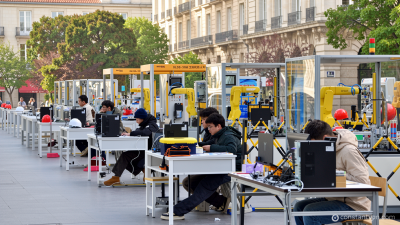
Constantvpn.com – The fluorescent lights hum over an assembly line in Chengdu, where roughly thirty middle-aged workers tighten screws, drill holes, and polish the metallic joints of a robotic arm. Beside them, four young engineers hunch over a console, wrestling with the firmware of a skeletal prototype that its creators hope will one day manufacture other machines. The juxtaposition is deliberate: old labour and new automation sharing the same concrete floor, the same shift schedule, the same narrow corridor between stations.
This scene captures the central tension of China’s current industrial strategy. While the country’s humanoid robots have become a global spectacle — sprinting, boxing, and marching at events like the second edition of the World Humanoid Games — the transformation that will actually reshape economies is happening in unglamorous workshops, paint booths, and welding bays. Machines that never sleep, never unionise, and never take a lunch break are scaling up at a pace that outstrips most Western manufacturing sectors.
The Numbers Behind the Noise
More than two million industrial robots now operate inside Chinese factories, a figure that exceeds the combined total of every other nation. The country also produces over half of all industrial robots sold worldwide, shipping them into automotive plants, electronics assembly lines, and energy infrastructure projects on every continent. The scale is not incidental; it is policy.
At the centre of that policy sits a roughly $20 billion (£14.7 billion) national innovation programme championed by President Xi Jinping, designed to position China at the cutting edge of advanced manufacturing and put it in direct technological competition with the United States. The programme funds research labs, subsidises component suppliers, and — critically — invests in the human pipeline needed to keep the machines running, maintained, and reprogrammed as product lines shift.
Training the Next Generation of Machine Operators
On the outskirts of Hangzhou, a former imperial capital whose skyline now bristles with data-centre towers and semiconductor campuses, the Hangzhou Technician Institute occupies a sprawling purpose-built campus. Its mission is blunt: churn out engineers who can programme, calibrate, and troubleshoot the robotic workforces flooding into Chinese factories.
Chen Tianyu, a 28-year-old instructor, spends his evenings and weekends inside operating plants so that his lessons track what is actually happening on the shop floor. In his classroom, around thirty college-age students stare at code editors while industrial arms wait in a row, awaiting their next programming exercise. One student, eyes flicking between monitor and machine, explains his task aloud:
“The idea is it will grab that cylindrical piece and move it over there.”
In another corner of the same room, a small group attempts to develop robotic instruments for medical procedures. Chen’s message to the cohort is unflinching:
“If you are not needed by the world of AI and robotics, then you’ll definitely be among those eliminated.”
He frames his own vigilance with a wry aside that underscores the velocity of change:
“I take a nap and the world changes.”
The institute is one of dozens of similar vocational schools springing up across the country, each calibrated to feed a specific industrial corridor. Together they represent a state-directed effort to ensure that the human side of the automation equation does not become a bottleneck.
Building the Builders
Back in Chengdu, the prototype that Pang Kai — a 31-year-old member of the research-and-development team — pushes across the factory floor is a sleek, skeletal frame. For now it can execute only simple, repetitive motions: scanning a QR code, repeating a fixed arc. Its ambition, however, is recursive. The goal is a machine that helps assemble other machines, compressing the build cycle and driving unit costs down.
“Maybe in another half year, it can do another task,” Pang says, smiling wistfully.
His employer, CRP Technology, has spent nine years refining robotic arms and employs roughly 300 people. Each arm is configurable to a client’s production line — automotive, consumer electronics, wind-turbine components — and the company states that a single unit can be programmed to execute more than 90 percent of repetitive tasks within its rated workspace. The implication for factory managers is straightforward: one well-tuned arm can replace dozens of manual stations, collapsing headcount while increasing throughput.
What the Transformation Means — and What Cannot Be Measured
The macroeconomic stakes are enormous. China sits at the gravitational centre of global manufacturing, trade flows, and supply-chain architecture. A sweeping shift toward robotic labour in that economy will ripple through export prices, employment structures, and the competitive calculus of every trading partner. Solar grids gleaming across provinces, electric-vehicle fleets that have silenced peak-hour traffic noise, and production lines running faster than any human sprinter are already visible markers of the shift.
Yet the human cost — displaced workers, regional unemployment spikes, the erosion of craft skills accumulated over decades — remains difficult to quantify in a political system that tightly manages information flow. Official statistics on factory employment, retraining uptake, and local labour-market stress are published with a lag and a selectivity that make independent verification challenging. The question of how many jobs the next wave of automation will displace, and how quickly displaced workers can be reabsorbed into maintenance, programming, or supervisory roles, is therefore as much a measurement problem as an economic one.
What is clear is direction. The state has committed capital, curriculum, and regulatory space to a single trajectory: machines that build machines, workers who speak fluent code, and a manufacturing base that treats uptime as a national-security variable. The quieter revolution — the one without spotlights or podiums — is already inside the factories, inside the classrooms, and inside the firmware of every arm waiting to be programmed.
Related Reading
Frequently Asked Questions
What is Beyond China s humanoid robots a quieter?
Beyond China s humanoid robots a quieter is the main topic of this guide. The article explains the context, practical details, and next steps readers should understand.
Why does Beyond China s humanoid robots a quieter matter?
Beyond China s humanoid robots a quieter matters because readers are looking for a useful answer, not just a short summary. Good content should match search intent and help them decide what to do next.