
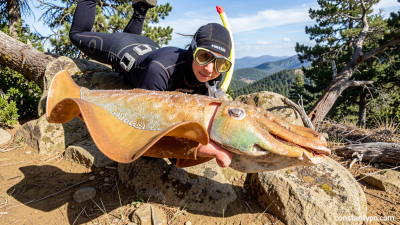
A 97% Collapse: Australia’s Iconic Cuttlefish Gathering Shrinks to a Fraction of Its Former Scale
Constantvpn.com – The shallow waters off South Australia’s southern coast, where hundreds of thousands of giant cuttlefish have historically converged each winter to mate, witnessed a scene this season that stunned marine biologists and conservation advocates alike. Official counts released this month place the number of adults arriving to breed at just 1,811 — a figure representing a 97% plunge from the roughly 63,000 recorded the previous year. It is the lowest turnout ever documented for what has long been billed as the planet’s single largest annual mating assembly of any cephalopod species.
What the Cuttlefish Coast Normally Looks Like
Each winter, a stretch of coastline in South Australia’s Great Southern region transforms into a spectacle unlike anything else in the marine world. Giant Australian cuttlefish — a species found nowhere outside Australian waters — migrate into the shallow bays and rocky shelves in enormous numbers. Females, capable of laying dozens of eggs each, arrive in their tens of thousands, while males display vivid, shifting colour patterns as they compete for mates. Thousands of recreational and scientific divers typically descend into the water to observe the event, which draws international attention to an otherwise remote stretch of coast.
The biological stakes of each season are extreme. Adult cuttlefish of this species have lifespans of roughly 12 to 18 months and die shortly after breeding. That means the reproductive output of a single winter effectively determines the size of the next generation. A weak season does not merely reduce numbers temporarily; it can set the population on a trajectory from which recovery becomes mathematically improbable.
A Survey Finds Almost Nothing
To gauge the severity of this year’s shortfall, South Australia’s Department of Environment and Water (DEW) dispatched a small team of divers to conduct an egg-count survey along the breeding grounds. Manny Katz, 28, was among four divers who spent two days in July completing eight one-hour dives, systematically examining the undersides of rocky reefs across approximately eight kilometres of coastline.
“Along the eight kilometres of coastline, there would normally be millions of eggs,” Katz explained, noting that each female typically deposits dozens of eggs and that tens of thousands of females ordinarily participate in the breeding cycle. “[We] pretty much looked under every single rock that we could have and we only found about 440 eggs.”
The contrast is stark. In a typical season, the rocky substrates along that same stretch of coast would be studded with millions of developing eggs. Finding fewer than five hundred suggests that the reproductive event, already diminished by the tiny number of arriving adults, produced almost no offspring at all.
The Algal Bloom and Its Timeline
The state government points to a persistent toxic algal bloom as the most probable driver of the collapse. First detected in March of last year, the bloom has ravaged South Australia’s coastline for more than eighteen months, killing marine life and degrading habitats across a vast area. The phenomenon — a rapid multiplication of algae in coastal waters — is naturally occurring in origin but is intensified by ocean warming, marine heatwaves, and nutrient runoff, all of which are amplified by ongoing climate change.
Katz noted that last year’s mating season proceeded largely unaffected because the bloom had not yet reached the Cuttlefish Coast. However, small concentrations of the toxic algae were detected in the area beginning in late last year, setting the stage for this year’s disaster. Cephalopods — including cuttlefish, octopuses, and squid — are known to be especially susceptible to the toxins produced by certain algal species, making the timing particularly ominous for the breeding population.
“Our marine habitats have been getting wiped out for the past year and a half now… this is an indicator that our marine ecosystems are in real big trouble — the canary in the coal mine, so to speak,” Katz said.
During the survey dives, the team also logged adult cuttlefish sightings. They observed roughly a dozen individuals where tens of thousands would ordinarily be present. Those few adults, Katz reported, displayed markedly altered behaviour — remaining skittish and concealed beneath rocks rather than engaging in the open displays typical of the breeding season.
“Because there’s so few cuttlefish hanging out at the moment, they don’t have strength in numbers,” he observed.
Conservation Response and Uncertainty
The near-total failure of this year’s reproductive event has intensified calls to formally list the giant Australian cuttlefish as a threatened species. Stefan Andrews, co-founder of the Great Southern Reef Foundation, has advocated for that designation, arguing that the combination of the algal bloom’s impact and the consequent collapse in next-generation recruitment warrants urgent protective status.
“The harmful algal bloom is a leading plausible explanation and appears likely to have contributed, but the available evidence does not yet allow us to say definitively that it caused the entire decline,” Andrews cautioned.
He emphasised that with so few adults observed and reproductive activity reduced to a negligible fraction of normal levels, the number of young entering the population next year will be vanishingly small. Whether the species can rebound from this year’s event remains an open question.
“Under our current circumstances, with there being so few eggs along the coastline, we don’t know if the population is ever going to be able to recover,” Katz said, adding that the answer will likely become clear within the next year or two, depending on whether this winter represents a true catastrophic decline or an anomalous dip.
For a species whose entire future hinges on a single annual reproductive window, the margin for error is effectively zero. The coming months will determine whether Australia’s most spectacular cephalopod gathering survives its darkest season yet.
Related Reading
Frequently Asked Questions
What is Australia usually hosts the world s biggest?
Australia usually hosts the world s biggest is the main topic of this guide. The article explains the context, practical details, and next steps readers should understand.
Why does Australia usually hosts the world s biggest matter?
Australia usually hosts the world s biggest matters because readers are looking for a useful answer, not just a short summary. Good content should match search intent and help them decide what to do next.