
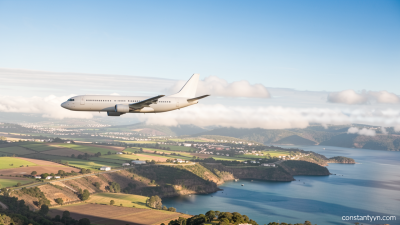
Artificial Intelligence Gets a £5 Million Mandate to Keep Aircraft Out of Climate-Harming Cloud Zones
Constantvpn.com – Every time a jet crosses the upper atmosphere on a cold winter night, its engines exhale a plume of superheated gas that slams into frigid air and crystallises into a thin ribbon of ice. Most of those ribbons dissolve within minutes. But under the right combination of temperature and humidity, they linger, spread laterally, and become small, high-altitude clouds that trap outgoing infrared radiation. Scientists estimate that this “contrail warming” effect accounts for roughly one-third of the total climate footprint of commercial aviation — a figure that, while uncertain in its exact magnitude, places the phenomenon firmly in the category of a major atmospheric problem.
Now a thirty-month programme called Operation Blue Skies will put machine-learning forecasting to work against that problem. Funded at a total of £5 million, the trial will test whether predictive algorithms can identify, hours before a flight departs, the pockets of atmosphere where persistent, heat-trapping contrails are most likely to nucleate — and then nudge aircraft away from those pockets through modest altitude adjustments.
Where and When the Trial Will Run
The designated test zone is the Shanwick Oceanic airspace, a sector in the eastern half of the North Atlantic corridor that carries a heavy share of intercontinental traffic. Researchers estimate this single region is responsible for approximately five percent of all global contrail warming, making it a high-impact but manageable sandbox for experimentation. Testing will be confined to selected evenings and nights across the winters of 2026–27 and 2027–28, periods when traffic density drops and the atmospheric conditions favour long-lived contrail formation. Roughly ten thousand flights are projected to transit the airspace during the trial windows, though only a small fraction will require an altitude deviation specifically to dodge a predicted contrail zone.
The Technology Behind the Avoidance
Google will supply the core predictive engine. The system ingests satellite imagery of past contrail events alongside historical flight-path data to build a statistical map of where persistent trails have historically formed. That map is then fused with real-time and forecast meteorological fields — temperature, humidity, wind shear — to generate a forward-looking probability surface of contrail nucleation. The output is handed to National Air Traffic Services (NATS), whose controllers can issue standard altitude-clearance instructions to pilots, shifting an aircraft up or down by approximately two thousand feet to place it outside the predicted formation zone.
The manoeuvre is deliberately unremarkable. Altitude changes of that magnitude already occur routinely to sidestep turbulence, icing, or convective weather, so passengers are unlikely to perceive any difference in cabin experience. Ian Jopson, director of sustainability at NATS, framed the operational impact plainly:
“Pretty much business as usual using existing procedures for the operators on the North Atlantic.”
Who Is Pulling the Strings
The consortium behind Operation Blue Skies spans public and private sectors. The Department for Transport is contributing £2.65 million, while Google is putting in £1.4 million through AI research, engineering staff, and computing infrastructure. The Met Office provides atmospheric data and modelling expertise, and academic partners at the University of Cambridge and Imperial College London supply the climate-science underpinning. Aviation Minister Keir Mather described the initiative as a test of “small tweaks to flight paths over the Atlantic” that could help make flying cleaner, adding:
“This is a world-first, and it’s British ingenuity leading the way.”
The Fuel-and-Carbon Arithmetic
Any altitude deviation burns a little extra jet fuel, which raises an obvious objection: could the carbon cost of the manoeuvre simply offset the warming benefit of avoiding the contrail? Dr Paul Hodgson, Google’s technical lead for the operation, pointed to earlier airline-level trials in which the additional CO₂ penalty was measured at well under one percent of the flight’s total emissions — a figure dwarfed by the contrail warming that would have been created had the aircraft stayed on its original track. Modelling specific to Operation Blue Skies suggests a full deviation through the Shanwick sector would add around one hundred kilograms of fuel per affected aircraft, a marginal increment against the radiative forcing of a persistent cirrus cloud.
Previous trials at the airline level have already demonstrated reductions of sixty to seventy percent in either contrail formation frequency or contrail warming magnitude when pilots follow avoidance guidance. Operation Blue Skies aims to validate those results at scale, in a live operational environment, with the added layer of real-time AI forecasting rather than pre-computed static zones.
Why the Timing Matters
The trial lands at a moment of heightened tension between aviation growth and climate targets. The UK government is simultaneously backing expansion of several major airports, and global passenger demand continues to climb. Separately, the same technology sector that is supplying the predictive algorithms is pouring billions into new data-centre construction — vast, power-hungry installations whose own carbon footprints draw scrutiny from environmental groups. Whether a modest altitude nudge, guided by a neural network, can meaningfully dent the climate impact of a growing aviation sector remains an open question. What Operation Blue Skies will establish, at minimum, is whether the forecasting accuracy is sufficient to make the nudge reliable enough for routine operational use — and whether the net climate arithmetic, once all variables are accounted for, genuinely favours avoidance over inaction.
Dr Hodgson offered a lighter note amid the technical detail, recalling how his five-year-old daughter labels the white streaks overhead:
“Sky graffiti.”
He acknowledged uncertainty around the precise share of aviation warming attributable to contrails but insisted the scientific community is confident the effect is “either quite a large problem or a very large problem.” Either way, the next two winters over the North Atlantic will provide the first large-scale, operationally integrated test of whether artificial intelligence can help erase that graffiti before it is written.
Related Reading
Frequently Asked Questions
What is AI to help planes avoid climate?
AI to help planes avoid climate is the main topic of this guide. The article explains the context, practical details, and next steps readers should understand.
Why does AI to help planes avoid climate matter?
AI to help planes avoid climate matters because readers are looking for a useful answer, not just a short summary. Good content should match search intent and help them decide what to do next.