
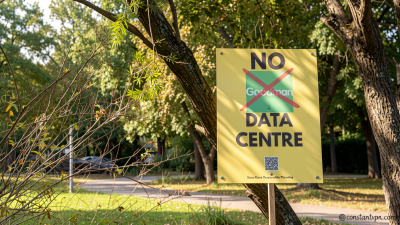
A Humming Presence: Australia’s Data Centre Boom Meets Neighbourhood Resistance
Constantvpn.com – In the quiet streets of Lane Cove, a leafy suburb on Sydney’s lower north-shore, residents are learning to live beside a sound they did not choose. Lucy*, a mother who asked to remain anonymous, describes the experience of putting her child to bed and hearing a low, unrelenting hum seep through the walls. The source sits just 350 metres from her front door — a data centre processing the digital traffic of millions. Four more facilities are queued for construction at the nearby industrial park, meaning the acoustic landscape of the neighbourhood is set to intensify considerably.
“I’ll hear it and think, ‘What is that? What is going on?'”
That question — what exactly is happening outside, and why — is now being asked across Australia as the country races to position itself at the centre of the global artificial intelligence infrastructure buildout. The sheer physical footprint of these facilities, combined with their relentless operational noise (described by some residents as resembling a jet preparing for takeoff, by others as a piercing high-frequency whine), has turned what was once an invisible utility into a visible, audible neighbour.
From Niche Utility to National Priority
Data centres have underpinned the digital economy since the internet’s mainstream arrival, originally housing servers that handled email, online banking, and cloud storage. The scale of the operation, however, shifted dramatically after 2022, when ChatGPT’s launch ignited a global scramble to build computing capacity capable of training and serving large language models. What had been a steady, incremental expansion became a sudden, capital-intensive sprint.
Australia has become one of the fastest-growing destinations for this investment. The country currently hosts 162 operational data centres, with plans already filed for another 90. An estimated more than A$155 billion (roughly £80 billion) in committed capital is lined up for projects across the continent. Investors are drawn by a combination of abundant renewable energy potential, natural gas reserves, available land, political stability, and membership in the Five Eyes intelligence alliance — factors that together make the country a comparatively low-risk jurisdiction for long-lead-time infrastructure.
Earlier this year, Sam Altman, chief executive of OpenAI, suggested publicly that Australia could become “a data centre capital of the world” if it chose to pursue that role. The country is already moving in that direction. In western Sydney, a facility rated at one gigawatt of power draw is planned — a scale that would make it Australia’s largest single consumer of electricity. Closer to completion, the Marsden Park project in the same region is already under construction and, when finished, will be the largest data centre in the Southern Hemisphere. It sits approximately 100 metres from a residential community.
The Economic Argument for Building
Leading economists and industry figures contend that without the data centre investment wave of the past two years, Australia would likely have slipped into recession. Jon Whittle, formerly director of the digital research centre at CSIRO — the nation’s flagship science agency — and now a prominent voice on AI policy, frames the choice in stark terms: the government effectively has no alternative but to continue down the investment path.
“There’s some very serious considerations around this, but my main message would be we need to lean into it.”
Belinda Dennett, chief executive of Data Centres Australia, reinforces the strategic logic. Australia records roughly 13.6 million monthly users of AI tools, placing it sixth in the world for active engagement with the technology. Dennett argues that domestic infrastructure lowers the barrier for homegrown AI companies to compete, rather than leaving the country permanently dependent on imported platforms.
“If we think about it in reverse, what happens if we don’t build infrastructure here? We get none of the value chain, we are just importing tools from someone else and we become just a user.”
She adds that the country’s skilled workforce, stable energy grid, and renewable energy potential further strengthen the case for domestic build-out.
The Energy and Water Question
Yet the economic case collides with hard physical limits. Leading energy and environmental analysts warn that Australia’s existing grid and water systems have limited spare capacity to absorb the demands of dozens of new gigawatt-scale facilities. The Australian Energy Market Operator projects that data centre electricity consumption could triple nationwide by 2030. Modelling suggests that without substantial additions of renewable generation and grid-scale storage, data centre load could push electricity prices in New South Wales up by as much as 26 per cent by 2035.
Water consumption compounds the concern. Large cooling systems draw heavily on local supplies, and in areas where water infrastructure is already stressed, the addition of multiple facilities raises questions about long-term sustainability. Residents near the Lane Cove cluster, in particular, fear that the surrounding national park and river corridor will bear the cumulative environmental impact of concentrated industrial development.
Latency, Sovereignty, and the Local Trade-off
Proponents point to a technical rationale that goes beyond raw compute: latency. The time it takes for data to travel between a user and a server matters enormously for applications such as air traffic control, robotic surgery, and real-time streaming. Dennett notes that modern users simply will not tolerate the delays that would result from routing Australian traffic through overseas facilities. Keeping processing close to the end user is, in her framing, a matter of both performance and digital sovereignty.
The tension, then, is not between building and not building so much as between where, how fast, and under what environmental conditions. Australia’s data centre boom is unlikely to reverse course — the capital is committed, the strategic incentives are strong, and the economic stakes are high. What remains contested is whether the country can absorb the energy, water, noise, and land-use consequences of that buildout without imposing disproportionate costs on the communities that find themselves, quite literally, next door to the machines powering the next decade of technology.
Related Reading
Frequently Asked Questions
What is AI data centres are booming in Australia?
AI data centres are booming in Australia is the main topic of this guide. The article explains the context, practical details, and next steps readers should understand.
Why does AI data centres are booming in Australia matter?
AI data centres are booming in Australia matters because readers are looking for a useful answer, not just a short summary. Good content should match search intent and help them decide what to do next.