A free Iran is their shared dream. But the diaspora remains torn on the best path forward.
A Free Iran is Their Shared Dream. But the Diaspora Remains Torn on the Best Path Forward
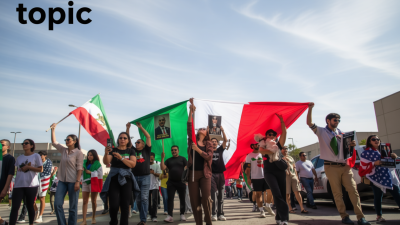
In Los Angeles, the Iranian diaspora found itself split into two opposing camps. On one side, crowds gathered near City Hall to condemn the beginning of an unapproved war, shouting “Stop the war in Iran” and “We the people don’t want war.” On the other, residents in Tehrangeles, a Westside neighborhood, celebrated the possibility of regime change, waving American, Israeli, and Iranian flags and dancing to lively music. The recent violence in the Middle East has sparked a mix of hope and fear among Iranians abroad, particularly those who fled theocratic rule after the 1979 Islamic Revolution.
Abbas Milani, director of Iranian studies at Stanford University, noted the growing tension. “Some are so angry at the regime that they’d support any action to dismantle it, even if it means damaging parts of the country,” he said. “Others want to remove the regime but avoid the chaos of war.” This divide contrasts with earlier this year, when the diaspora showed unity in backing Iranians resisting the government’s harsh measures. Now, the conflict has deepened internal debates.
Online discussions have intensified since the U.S.-Israeli strikes on Iran. Supporters of military action are called “Zionists,” a term that has evolved into a derogatory label for Jews following Hamas’s attacks on Israel in October 2023. Conversely, those advocating peace are accused of favoring the current regime. Iranians also argue over potential leadership after Khamenei’s death, with some favoring Reza Pahlavi, the son of Iran’s last monarch, while others distrust the monarchy’s legacy.
The situation is compounded by Iran’s internet blackout, which has isolated many from loved ones. With Nowruz, the Persian New Year, approaching, the community faces uncertainty. Rumors suggest Mojtaba Khamenei, Khamenei’s son, might succeed him. Meanwhile, the Islamic Revolutionary Guard Corps stands to gain more influence if the current conflict continues, according to analysts.
President Donald Trump recently hinted at removing Iran’s leadership, proposing names for a “good leader.” However, a recent NBC News poll reveals 54% of potential voters disapprove of his approach. This mirrors the split within the Iranian diaspora, where 53% opposed U.S. military action in a prior NIAC survey. Jamal Abdi, NIAC president, mentioned a new poll will release updated figures next week.
Los Angeles-based pastor Ara Torosian, a Christian who left Iran in 2010, expressed heartbreak over the destruction of historic sites and the loss of innocent lives, especially children. Yet he views the current suffering as a stark contrast to decades of repression faced by dissidents. Torosian, who was jailed and beaten for Christian symbols in his Tehran home, cheered the death of Khamenei. “This is not just a political victory—it’s a personal one,” he remarked.
The Iranian Diaspora Collective, an Instagram account with 81,000 followers, emphasized the community’s diversity. “Millions will never align on ideology or identity, and that diversity is what strengthens a free society,” the group wrote. As the death toll rises and tensions mount, the path to a free Iran remains unclear, with the diaspora struggling to find consensus.
