
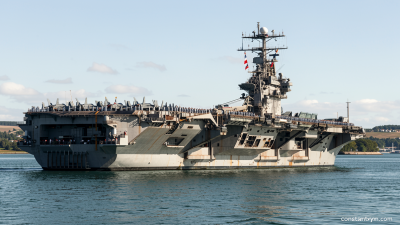
A Floating Prison: Life Inside a US Aircraft Carrier
Constantvpn.com – For the sailors locked below decks of a US Navy aircraft carrier, the vessel functions as a floating prison — a sealed steel world where daylight is a rumor and the walls vibrate with the thunder of jet engines, gun barrels, and hydraulic arrestor cables slicing through bulkheads mere inches from a bunk. Crew members assigned to lower compartments may go weeks, sometimes months, without stepping into open sky. The bunks themselves, derisively called “coffin racks,” offer barely enough room to turn over in sleep. It is a reality that has now become the subject of a heated public debate over conditions aboard the USS Abraham Lincoln, deployed as part of the US-Iran conflict since 11 December.
The Lincoln’s current tour stretches well beyond the duration of most prior carrier deployments, and questions have mounted about what sustained confinement at sea does to the men and women inside it. For those who have served long tours before, the comparison is immediate and uncomfortable.
What a Photographer Saw: The Slow Fade
Jonny Burnell spent 111 days aboard the USS Carl Vinson during the opening phase of the US war in Afghanistan in 2001. Working as a Navy photographer, he enjoyed unusual mobility compared with sailors locked into a single department — he moved through every level of the ship, capturing portraits of crew members eager, in a pre-digital era, to have their image preserved.
Over those three-plus months, Burnell watched the ship’s atmosphere erode. The initial energy and novelty bled away, replaced by what he describes as a creeping emptiness settling over the decks.
“There was one point where there was a visible kind of deadness in the shipmates’ eyes,” he recalls. “I still think the hardest part of my job was watching the sadness in people’s faces every frickin’ day.”
Burnell told the BBC he has been watching coverage of the Lincoln’s situation on the verge of tears, given that the current deployment has already stretched past twice the length of his own Vinson tour. He described the experience as watching a floating prison slowly grind down the people inside it. One colleague aboard the Vinson, Burnell notes, did everything within his power to be discharged early — selling drugs and running what he called an “underground rave club” in the ship’s lower levels.
Reports from Families and Service Members
Two US military-focused publications, the Military Times and Stars & Stripes, have described food shortages, malfunctioning plumbing, and deep exhaustion among personnel on the Lincoln. Relatives of sailors aboard have voiced alarm over deteriorating mental health, and some crew members have reportedly attempted to jump overboard.
In a conversation with the BBC, a relative of one Lincoln sailor said their family member had lost 65 pounds (29 kilograms) and was suffering from exhaustion driven by the ship’s relentless noise and vibration. The relative described the vessel as a floating prison from which there is no practical escape once the tour begins.
It remains unclear what daily life on the Lincoln looks like right now. A CNN crew spent three days aboard last month and did not find widespread problems. Several troops they spoke with mentioned being forced to ration meals and losing weight over “many months,” yet when the reporters boarded on 7 July, food was described as plentiful. Showers ran hot, though patches of mould were visible in some areas.
Official Pushback and the Question of Scale
Military leadership has pushed back against the narrative of crisis. On Sunday, Admiral Brad Cooper, head of US Central Command — the theater command overseeing operations across the Middle East — issued a statement noting that of the 11 active aircraft carriers in the US fleet, “the Lincoln currently has among the lowest number of cases related to mental health.”
“This doesn’t mean all is perfect,” Cooper said, adding that “service at sea for long periods isn’t for everyone.” He continued: “It is uniquely challenging and tough,” and stressed that “mental health is another aspect of individual health and requires our attention just like physical health and spiritual health.”
Retired Navy Lt Commander Steve Rogers, who directs the Association of the United States Navy (AUSN), a non-profit organization supporting US Navy servicemembers and their families, has been in regular contact with relatives of troops on the Lincoln. He characterizes the media coverage as “99% hype” and says it is entirely normal for families to worry when a loved one is deployed to a combat zone. In his view, the sailors are well prepared for the conditions they face.
President Trump, asked about the situation aboard the Lincoln on Friday, dismissed the reports entirely, saying the deployment is “not nearly long enough.”
Why the Debate Matters
The Lincoln’s situation sits at the intersection of several long-running questions in naval service: How long can a crew sustainably operate at sea before morale, physical health, and cognitive function begin to degrade? Is the current deployment architecture — which can keep a carrier and its air wing on station for extended stretches — compatible with the human limits of the people who man it? And when a vessel functions, in effect, as a floating prison for its crew, what obligations does the service owe those confined within it?
Those questions are not new. They have echoed through carrier decks for decades. What is new is the scale of public attention, fueled by social media and a political moment in which the Lincoln’s mission has become a proxy for broader debates about military readiness, leadership accountability, and the cost of prolonged conflict.
Frequently Asked Questions
How long is a typical aircraft carrier deployment?
Most US Navy carrier deployments run roughly six to eight months, including transit and return. The Lincoln’s current tour, which began on 11 December as part of the US-Iran conflict, has already exceeded that benchmark and, according to former crew members, stretches past twice the length of earlier tours.
What conditions do sailors report on long deployments?
Commonly cited issues include chronic noise and vibration from jet operations, limited personal space in lower-deck bunks, food rationing during peak operational tempo, plumbing failures, mould in some compartments, and cumulative fatigue. Mental-health strain — described by veterans as a “deadness” in crew members’ eyes — tends to build gradually over weeks.
Can a sailor leave the ship early if conditions become unbearable?
In practice, early discharge from a deployed carrier is rare and typically requires a medical or administrative justification. Former crew members describe the vessel as a floating prison in the sense that, once the ship is at sea and on mission, there is no practical mechanism for an individual to simply step off. Requests for early release are processed through chain-of-command channels and are granted only in exceptional circumstances.
What is the US Navy’s official position on the Lincoln’s conditions?
Admiral Brad Cooper, commander of US Central Command, stated that the Lincoln has among the lowest mental-health case counts of the 11 active carriers, while acknowledging that long service at sea “isn’t for everyone” and that mental health requires attention alongside physical and spiritual well-being. AUSN director Steve Rogers called much of the coverage “99% hype” and said families’ worry is a normal response to combat-zone deployment.