Scientist publishes fresh doubts over Microsoft’s quantum claims
Scientist publishes fresh doubts over Microsoft’s quantum claims
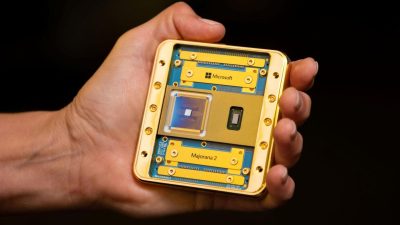
Scientist publishes fresh doubts over Microsoft – Questions have been raised about Microsoft’s quantum computing advancements following a recent analysis by Dr. Henry Legg, a physicist based in the UK. In a paper featured in the science journal *Nature*, Legg challenged the tech giant’s assertion that it has achieved a major breakthrough with its Majorana 2 chip. The critique focuses on a software tool used by Microsoft to validate its quantum research, which Legg claims contains coding errors and lacks precision in its measurements.
Majorana particles under scrutiny
Legg’s concerns center around Microsoft’s theoretical claim of creating a Majorana quasi-particle, a fundamental component in its approach to quantum computing. He argues that the company has not yet provided conclusive evidence to support this assertion, which is pivotal to its strategy. “The software tool did not accurately interpret the data, leading to misleading conclusions,” Legg stated in his analysis. He further emphasized that Microsoft’s research remains unverified by the broader scientific community, which typically relies on rigorous scrutiny and peer validation to accept new findings.
“Last year Microsoft claimed they had built the equivalent of a precision Swiss watch. However, when I opened the case to examine the mechanism, I found what looked like a chaotic jumble of mismatched parts,” Legg said. “Something was making noise, but it didn’t look like the breakthrough they had promised.”
Despite these criticisms, Microsoft has maintained its position, asserting that its conclusions are well-supported by experimental data. Dr. Chetan Nayak, a Microsoft Technical Fellow and Corporate Vice President in Quantum Hardware, defended the company’s work. “At the end of the day, success is the delivery of a scalable quantum computer,” Nayak explained. “Scepticism and rigour are hallmarks of the scientific process, which we appreciate and have supported through collaboration with various academics.”
Quantum computing’s industry-wide challenges
Quantum computing has emerged as a rapidly growing field, with global investment exceeding billions of dollars. However, the technology remains in its infancy, as current devices struggle with reliability. Even minor disturbances, such as vibrations or temperature fluctuations, can cause quantum machines to produce errors. This fragility underscores the difficulty of achieving stable, large-scale quantum systems, a hurdle that Microsoft claims to be overcoming through its unique approach.
Microsoft’s strategy relies on Majorana particles, which are theorized to be stable quantum states that could serve as error-resistant building blocks for qubits. This method is rooted in a 90-year-old physics theory, combined with the study of exotic materials that exist in a state of matter neither liquid, solid, nor gas. The company has pursued this path for over two decades, positioning itself as a leader in the race to develop practical quantum computers.
Past controversies and recent developments
The skepticism surrounding Microsoft’s work is not new. In 2021, a paper from a Microsoft-backed laboratory that claimed to have discovered evidence of the Majorana particle was retracted due to methodological flaws. This event highlighted the challenges of validating quantum claims. More recently, in 2025, *Nature*’s editors added a note to Microsoft’s paper, cautioning that the results did not definitively prove the existence of Majorana zero modes in the reported devices.
Microsoft, however, has since unveiled a second-generation Majorana chip, which it describes as 1,000 times more reliable than its predecessor. The company maintains that this upgrade addresses previous concerns, though Legg and others argue that the software tool’s limitations still need to be resolved. Microsoft asserts that it is sharing all relevant data with the U.S. Defense Advanced Research Projects Agency (DARPA) for independent evaluation, while citing commercial sensitivity as a reason for withholding broader publication.
Quantum’s complexity and the path forward
Quantum computing is a strange and complex field, still grappling with foundational questions. Its potential to revolutionize industries by solving problems beyond the reach of classical supercomputers has driven intense competition among tech firms. Yet, the path to practical implementation is fraught with challenges. Legg’s critique, for instance, points to the need for more transparent data sharing to allow external verification.
Microsoft’s confidence in its approach remains unshaken, even as experts debate its validity. The company’s long-term commitment to the field has led to significant innovation, but its latest claims now face fresh scrutiny. While the Majorana 2 chip represents a step forward, the scientific community continues to demand more evidence before endorsing its breakthrough status.
Quantum question time
Microsoft’s work has sparked widespread interest, prompting discussions about its implications for the future. In a segment titled “Quantum question time,” Tech Life addressed listener inquiries on the basics of quantum computing and its potential impact. One question highlighted the timeline for practical quantum computers, with Microsoft asserting that they could be developed within years, not decades.
Another query focused on the sub-zero environments required to sustain quantum states, a topic explored in a feature about the world’s most powerful supercomputers. The article noted how extreme cooling is essential to minimize interference and maintain the delicate conditions necessary for quantum operations. These insights underscore the technological hurdles that must be overcome for quantum computing to reach its full potential.
As the debate continues, the scientific community remains divided. While Microsoft’s advancements are impressive, the need for independent verification persists. Legg’s paper serves as a reminder that even the most promising technologies require thorough examination. The industry-wide effort to improve reliability and accuracy will determine whether quantum computing can fulfill its promise of solving complex global challenges.
Conclusion and next steps
The tension between innovation and validation is central to the progress of quantum computing. Microsoft’s Majorana 2 chip, though a notable development, has not yet silenced critics. With the stakes high and the timeline compressed, the company faces the challenge of proving its claims while navigating the intricate landscape of quantum research. For now, the scientific community watches closely, waiting for further evidence to confirm or refute the breakthroughs that could reshape the future of technology.
