Iran v Iran in the stands as politics and football intertwine
Iran v Iran in the Stands: Politics and Football Intertwine
Iran v Iran in the stands – Iran’s dramatic 2-2 draw with New Zealand in the World Cup group stage match highlighted a deeper divide beyond the pitch. While the game was officially promoted as an Iran vs New Zealand encounter, the fans in the stands and chanting outside the stadium revealed a different narrative—one where the opposition was not the New Zealanders but a group of Iranian dissidents. The atmosphere outside Los Angeles Stadium was electric with political tension, as supporters waved flags that symbolized conflicting ideologies.
Flags of Contradiction
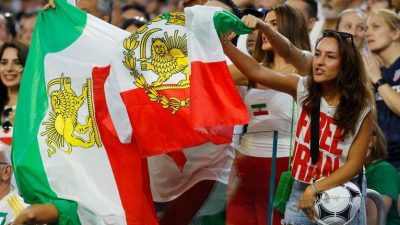
Thousands of Iranian flags filled the stands, but their designs told a story of division. From afar, they appeared uniform, but up close, the differences were striking. Some bore the Islamic Republic’s official emblem, while others carried the pre-revolutionary Lion and Sun, a symbol of Iran’s past regime. These flags, adorned in the nation’s colors, became a canvas for dissent. For many Iranian-Americans, the Lion and Sun flag represents resistance against the current government in Tehran, despite FIFA’s ban on political symbols inside stadiums.
Outside the stadium, a crowd of several hundred protesters gathered, voicing their frustration with FIFA’s decision to allow the flags in the stands. Their anger was directed at both the international football governing body and the national team, which they viewed as an extension of the Islamic Republic’s authority. “Mullahs’ team is not my team,” one group chanted, while another sang for “regime change in Iran.” The protest reached a crescendo as they sang Iran’s pre-revolutionary national anthem, a moment that resonated deeply with those present.
“It means freedom and pride,” said a young man who translated the lyrics. His words captured the emotional weight of the moment, where a symbol of past glory became a rallying cry for change.
Inside the stadium, the mood was markedly different. Cheers erupted when Iran scored, and the players received a wave of support from fans who saw them as representatives of the nation’s spirit. Yet, the crowd’s dual identity was evident—supporting the team while questioning its alignment with the government. The match, therefore, became a stage for an internal conflict: Iran versus Iran.
Voices of Dissent
Samaneh, an Iranian-American who has lived in the U.S. for a decade, described the scene as a complex tapestry of loyalty and dissent. “I’m here to support Iran, not the regime,” she said, reflecting the personal ties many have to their homeland. Her emotional connection was palpable, especially as she recalled her mother, still in Iran due to bureaucratic hurdles and President Trump’s travel restrictions. “I’m worried about her all the time,” she added, her voice trembling. “I’m also scared to return home.”
The protests outside were fueled by frustration over the recent U.S.-Iran agreement, which some saw as a compromise that failed to address the country’s struggles. Nini, a demonstrator, emphasized the stakes: “We don’t want a deal. The people of Iran deserve regime change. People were slaughtered on the streets of Tehran.” Farimah, wearing a Lion and Sun shirt, echoed this sentiment. “This team doesn’t represent the people of Iran,” she said, underscoring the belief that the players were complicit in the regime’s policies.
“We can’t normalize what happened in January through a sporting event,” Farimah stated, her words carrying the weight of recent protests and their human toll.
Among the protesters stood Kourosh, holding a makeshift noose around his neck. “It’s a symbol to stop the execution of brave and innocent people in Iran,” he explained. His gesture was a powerful statement, linking the match to the broader political and social struggles within the country. Many in the crowd shared his view, believing the players on the field were not champions of the people but figures representing the regime’s interests.
Supporters and the Spirit of Unity
Despite the tensions, some fans remained steadfast in their belief that football could transcend politics. Mostafa, an Iranian-American heading into the stadium, argued that the team should be seen as a unifying force. “Soccer is about friendship, cultural connections, and putting politics aside,” he said, his words a counterpoint to the outside dissent. For him, the match was an opportunity to celebrate the shared identity of Iranians, both at home and abroad.
Pourmand, who traveled from San Diego to Iran’s training camp in Tijuana, Mexico, echoed this sentiment. Having attended previous World Cups in Qatar and Russia, he stressed that the players were not political actors but athletes striving to represent their nation. “The people of Iran are represented by these players,” he said, adding that their presence was a message of hope and human values. “They’re here to show we’re worthy of being here.”
Elika, another Iranian-American supporter, felt torn between her loyalty to her country and her dissatisfaction with its government. “I’m able to separate the team from the government,” she said, honoring her late father’s tradition of supporting Iranian football. Her attendance was a tribute to both her heritage and the legacy of those who came before her. Yet, the political undercurrents of the event could not be ignored.
The match’s outcome—Iran’s come-from-behind draw—symbolized the resilience of the team and the nation. But for the fans outside, it was a reminder of the ongoing struggle for representation and freedom. The clash of symbols, from the flags to the anthems, underscored a reality where football became a battleground for conflicting narratives. As the game unfolded, the contrast between the supporters inside and the protesters outside painted a vivid picture of a country divided, yet united in its passion for the sport.
In the end, the event was more than a football match. It was a microcosm of Iran’s internal dynamics, where the nation’s athletes became a focal point for both pride and protest. For the players, the game was a chance to prove their worth on the world stage. For the fans, it was a test of their convictions, as they navigated the delicate balance between national pride and political dissent. The story of Iran v Iran, both on and off the pitch, remains a testament to the power of sport to reflect—and sometimes shape—the world around it.
