
Portsmouth Confrontation Escalates as Anti-Migrant Tensions Grip the Coast
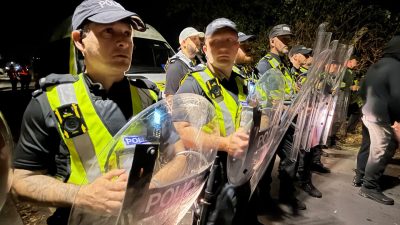
Constantvpn.com – The arrival of 120 migrants in a single small dinghy off the Hampshire coast has ignited a volatile chain of demonstrations along England’s south-east shoreline, culminating in a Sunday-night clash in Portsmouth where roughly two hundred demonstrators — several of them masked — squared off against officers in full riot gear. The incident, which left several police personnel injured and multiple vehicles damaged, has drawn sharp condemnation from government ministers and sharpened an already fractious national debate over small-boat crossings of the English Channel.
A Night of Disorder at Eastney
The trouble erupted around the Eastney Landing ferry port area, the point where the migrants had been brought ashore after crossing from France. As crowds descended on the site, police moved to shield a line of coaches parked along a road leading away from Eastney Marina. Traffic was blocked, and officers issued a formal dispersal order, meaning anyone who failed to comply could be arrested on the spot.
Hampshire and Isle of Wight Constabulary confirmed that a small number of officers received treatment at the scene for injuries, none described as serious. The force issued a statement making clear its position:
“Violence and criminal damage have no part in peaceful protest. No arrests have been made at this time, however an investigation to identify offenders responsible for any assaults to officers, criminal damage to vehicles or other criminal offences has been launched.”
Spencer Wragg, chair of the Hampshire Police Federation, voiced frustration over what he described as a targeted assault on officers. He noted having seen video of officers pushed from their motorbikes and photographs showing police vehicles vandalised.
“It appears that the police last night became the target for some of the protest.”
Ministerial Condemnation and Political Fallout
On Monday, Policing Minister Sarah Jones addressed the House of Commons to denounce the Sunday-night disorder, labelling it “intimidating and thuggish.” She drew a firm line between lawful demonstration and criminal conduct:
“Peaceful protest is a fundamental part of our democracy and it must be defended. But so too is the right of other citizens to go about their lives without undue interference – and there can be no excuse for threatening behavior or serious disruption.”
“Let me therefore make clear to the House and to the country that disorder of any kind will never be tolerated and those who cross the line from peaceful protest into ILlegality will face the full force of the law.”
Shadow Home Secretary Chris Philp condemned the violence in Portsmouth but used the moment to press a broader argument, suggesting the government should heed the anger of far more than the protesters visible on the streets.
“This should also be a wake-up call for the government because it’s not just those protesters in Dover and Portsmouth who feel so angry about large-scale illegal immigration. It is millions and millions of people up and down this country who feel angry as well.”
Nigel Farage, leader of Reform UK, posted a video to social media in which he warned the country sat on the edge of “serious civil disturbance” while urging demonstrators to keep their actions peaceful. He added: “Peaceful protest: good. Uniforms and masks: bad. Voting is the only way we get a solution.”
The Dover Prequel and Local Council Anger
The Portsmouth confrontation was the latest episode in a weekend of disruption that began on Saturday at the Port of Dover, where a large group of masked men staged a demonstration over small-boat crossings, causing significant transport chaos. Portsmouth City Council turned its attention to the Home Office, with council leader Steve Pitt describing the decision to land the migrants in the area as causing “needless disruption.” The council said the department had “serious questions to answer” over the choice of landing site.
Daniel Thomas, widely known as Danny Tommo and an associate of far-right campaigner Tommy Robinson, was livestreaming from the Portsmouth scene, urging his online audience to “get down to Eastney” and prevent the migrants from being moved on. Footage shared on social media appeared to show protesters trailing the convoy of coaches along a motorway after it departed, apparently attempting to intercept the journey toward the Manston processing centre in Kent. Border Force confirmed that individuals from the boat had been transported outside Hampshire for processing in the early hours of Monday.
Small-Boat Crossings: Numbers and Legal Context
The protests sit atop a long-running controversy over how people reach Britain from continental Europe. Between 1 January and 6 September 2026, a total of 17,138 people crossed the English Channel by small boat from France — a figure down by 43 per cent compared with the same period the previous year. Despite that decline, small-boat arrivals have remained the most common route by which people are detected entering the UK without permission since 2020.
Nearly all those who arrive by small boat subsequently claim asylum. Under international law, specifically the 1951 Refugee Convention and its 1967 Protocol, a person who lodges an asylum application is entitled to remain in the country while that application is assessed. They cannot be removed until a decision has been made, which means that even a single dinghy carrying dozens of passengers triggers a chain of processing obligations for the state. The Manston centre in Kent, where migrants from the Portsmouth landing were ultimately taken, is one of several sites used for initial registration and screening before individuals are dispersed or their claims progress through the system.
The combination of high-profile arrivals, social-media amplification by organisers such as Danny Tommo, and a political environment in which immigration remains a central electoral issue has created conditions in which what begins as a local logistics decision — where to land a boat, which coaches to use, which processing centre to employ — can rapidly escalate into a public-order event drawing ministerial intervention and cross-party commentary within hours.
Related Reading
Frequently Asked Questions
What is Minister condemns disorder at Portsmouth anti?
Minister condemns disorder at Portsmouth anti is the main topic of this guide. The article explains the context, practical details, and next steps readers should understand.
Why does Minister condemns disorder at Portsmouth anti matter?
Minister condemns disorder at Portsmouth anti matters because readers are looking for a useful answer, not just a short summary. Good content should match search intent and help them decide what to do next.