
Portsmouth Roads Sealed as Hundreds Demand Migrants Stay Put After Channel Dinghy Rescue
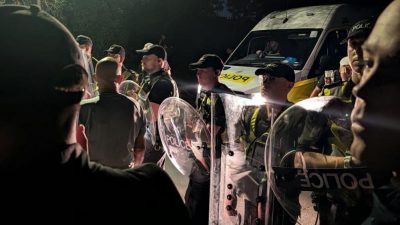
Constantvpn.com – A tense standoff unfolded along the waterfront of Portsmouth on Sunday evening when hundreds of demonstrators converged on the Eastney Landing ferry port area, physically blocking roads in an attempt to prevent roughly 140 migrants from departing the city. The group had been pulled from a single small dinghy in the English Channel earlier that day, making the incident the second major anti-migrant confrontation of a volatile weekend for British authorities.
Hampshire Police confirmed a formal dispersal order was active at the scene, warning that anyone refusing to clear the roadway faced arrest. Officers equipped with riot shields formed protective lines around a cluster of coaches parked along a road exiting Eastney Marina, while protesters packed the surrounding streets and chanted demands to halt the onward movement of the rescued passengers toward the Manston processing centre in Kent.
The Crossing: A 170-Mile Departure from Normandy
The vessel that carried the group into UK waters had launched not from the usual departure points near Calais but from the Bay of the Seine, approximately 170 miles to the west. French authorities described the departure as highly unusual, noting that it stretched the crossing distance considerably beyond the norm. French rescue boats shadowed the dinghy for roughly ten hours during its transit, monitoring for signs of distress.
The French coastguard determined it was not safe to attempt to intercept or stop the craft while it remained on open water. By lunchtime the boat had entered UK territorial waters, where lifeboats dispatched from Bembridge and Yarmouth met it and brought the passengers ashore safely.
The Maritime and Coastguard Agency confirmed that following a report received on 6 September of a small boat heading toward the Hampshire coast, HM Coastguard deployed lifeboats, a helicopter, an aeroplane, and dedicated Rescue Teams. Border Force, Border Security Command, Hampshire Police, and South Central Ambulance Service were all activated in parallel.
Protesters and Political Reactions
Many of those gathered at Eastney were dressed in black and wore face coverings. Among them was Daniel Thomas, widely known as Danny Tommo, an associate of far-right campaigner Tommy Robinson, who broadcast live from the scene. He declared to his audience:
“Roads are all blocked, they are never going to be able to leave here.”
The government moved quickly to distance itself from the disorder. A spokesperson condemned what was described as “the intimidating and thuggish behaviour” of the crowd, while adding:
“The right to peaceful protest is fundamental to our democracy, but it must never cross a line into disorder. We thank the emergency services who are working to safely manage this situation.”
Reform UK leader Nigel Farage seized on the episode to attack the government’s border strategy, posting on X:
“This week Andy Burnham struck an agreement for 45 more officers on French beaches. Today a boat launched from Baie de Seine, 170 miles from Calais, arriving on the beaches of Hampshire for the very first time. This is a joke. Only Reform will send the boats back.”
Joe Robertson, the Conservative MP for Isle of Wight East, weighed in separately, calling it “extremely concerning to see an illegal migrant crossing this far west.”
The Dover Precedent: Saturday’s Disruption
The Portsmouth confrontation followed directly on the heels of a similar demonstration at the Port of Dover on Saturday, where hundreds of masked protesters blocked roads and were heard chanting “stop the boats.” Kevin Mills, leader of Dover District Council, told the BBC that the demonstrators “caught several agencies on the hoof” when they arrived, and criticised what he described as a slow police response to what he called an “exceptionally well organised” operation. Kent Police had not issued a formal comment at the time of reporting, though cabinet minister Jonathan Reynolds stated that officers “did deal with it swiftly.”
Broader Context: Border Policy and Channel Statistics
The two protests landed amid heightened political attention on small-boat crossings. Days before the weekend, Prime Minister Andy Burnham and French President Emmanuel Macron met to discuss how to “scale up” joint efforts to reduce the number of people attempting the Channel passage in small craft. Last year, local officials flagged a noticeable rise in departures originating from Normandy rather than the traditional Calais corridor.
In August, a single small boat carrying a record 230 people completed a Channel crossing, underscoring the scale of the challenge. Between 1 January and 1 September 2026, a cumulative total of 16,513 people crossed the English Channel.
A Home Office spokesperson framed the government’s response in numerical terms, stating that joint efforts had seen over 48,000 crossing attempts prevented and 1,100 boats and engines seized since the election. The department added that a newly signed payment-by-results arrangement with France would place 40 per cent more personnel on French beaches to intercept vessels before they launch.
For the residents of Portsmouth and the wider Hampshire coast, the Sunday standoff raised immediate practical questions about ferry operations at Eastney Landing, local road access, and the longer-term question of how many more such arrivals the area’s infrastructure and public patience can absorb before political pressure forces a harder response.
Related Reading
Frequently Asked Questions
What is Protesters block roads in Portsmouth after 140?
Protesters block roads in Portsmouth after 140 is the main topic of this guide. The article explains the context, practical details, and next steps readers should understand.
Why does Protesters block roads in Portsmouth after 140 matter?
Protesters block roads in Portsmouth after 140 matters because readers are looking for a useful answer, not just a short summary. Good content should match search intent and help them decide what to do next.