
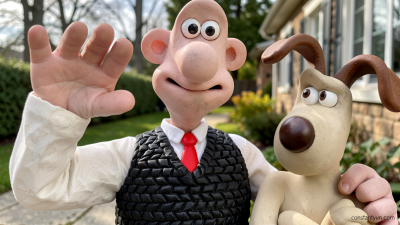
Half a Century of Clay, Chance, and Creative Defiance: Inside Aardman’s Unlikely Rise
Constantvpn.com – In 1976, two school friends in Bristol decided to make films out of plasticine. Fifty years later, that impromptu pastime had grown into one of the most decorated animation studios on the planet, responsible for characters that have become as recognizable as any Hollywood icon. As Aardman Animations marks its golden jubilee, the studio’s founders and key creatives have opened up about the near-misses, lucky breaks, and stubborn creative choices that shaped its trajectory from basement hobby to Oscar-winning institution.
The studio’s founding story is deceptively simple. Sir Peter Lord and Sir David Sproxton, who met as teenagers, began experimenting with stop-motion techniques in the mid-1970s. What started as informal tinkering with modelling clay gradually hardened into a professional operation, eventually producing Morph, Wallace and Gromit, Shaun the Sheep, and Chicken Run — the latter being the highest-grossing stop-motion feature ever released.
The Cat That Never Was
Perhaps no single creative decision better illustrates how accident can outperform intention than the origin of Gromit. The silent, expressive canine companion of inventor Wallace first appeared on screen in 1989, but for a brief period during development, the character was supposed to be a feline.
Animator Nick Park, who joined the studio in 1985, had conceived the premise of a bespectacled Englishman constructing rockets in his basement. He initially envisioned a pet cat to accompany the inventor.
“I started modelling the cat, and it was just very difficult, so I thought I’d do a dog instead!”
That pragmatic substitution — born of sculptural frustration rather than narrative planning — produced one of animation’s most beloved sidekicks. Park was working on A Grand Day Out at the National Film and Television School in London when Lord and Sproxton visited to address students. Their assessment of his talent was immediate and unreserved.
“We met him and thought, ‘Oh, he’s good’. In fact, he’s very good. Now I know him, he’s actually a genius,”
The collaboration proved explosive. A Grand Day Out earned an Oscar nomination in 1990, ultimately losing to another Aardman production, Creature Comforts, also helmed by Park. Park would go on to collect three additional Academy Awards over the following decades.
Dinner with Spielberg and the Chicken Gamble
By the mid-1990s, Wallace and Gromit had made Aardman a household name in animation circles. That visibility led to an improbable dinner table conversation with Steven Spielberg and DreamWorks chief executive Jeffrey Katzenberg. Lord pitched a concept that married Spielberg’s fondness for classic cinema with the studio’s clay-based expertise.
“We want to do The Great Escape,” Lord told Spielberg. “But with chickens.”
Katzenberg, a longtime admirer of the Bristol studio, recalled harboring a quiet hope of collaboration. Park remembered the director’s reaction with characteristic warmth:
“Spielberg said, ‘The Great Escape is one of my favourite films, and I have 300 chickens on my ranch!’ So it went very well.”
The resulting project, Chicken Run, represented an unprecedented technical undertaking: a full 90-minute feature rendered entirely in stop-motion clay. The budget exceeded £20 million, and Aardman insisted that every single frame be photographed in its Bristol facilities rather than outsourced. The commercial payoff was extraordinary — the film grossed more than $220 million (£165 million) globally and still holds the record for the highest-earning stop-motion feature.
Inventing an Oscar Category
Despite its box-office dominance, Chicken Run did not take home an Academy Award. The reason was structural rather than artistic: at the time, no category existed for animated feature films. The Wrong Trousers had won the short-film Oscar in 1994, but a full-length animated picture simply had nowhere to compete.
Radio 1 film critic Ali Plumb explained the consequence:
“And so because they couldn’t give Chicken Run a little golden man, they invented the category.”
The Academy introduced the Best Animated Feature award the following year. Within a few years, Wallace and Gromit themselves claimed that new honour for The Curse of the Were-Rabbit, completing a full circle of recognition.
Shaun’s Silent Revolution
Another character born from the Wallace and Gromit universe would go on to achieve a different kind of global dominance. Shaun the Sheep first appeared in the 1995 short A Close Shave and quickly became the studio’s most internationally recognized mascot. Like every animal in the Aardman world, Shaun communicates exclusively through bleats, grunts, and extraordinarily animated facial expressions.
Aardman Managing Director Sean Clarke has noted that this linguistic absence is precisely what grants the character universal accessibility:
“The beauty of Shaun is it transcends borders and cultures because it doesn’t rely on the spoken word. You can literally see Shaun the Sheep here in Bristol and in Outer Mongolia.”
Yet the studio’s commercial partners repeatedly pushed for spoken dialogue. When the Shaun the Sheep television series launched, executives urged the addition of voices. The same pressure resurfaced when a feature-length Shaun film entered development for 2015.
“They said, ‘You can’t do 80 minutes without any dialogue’.”
The studio held its ground. The decision reinforced a principle that has underpinned Aardman’s output since its earliest clay experiments: that physical comedy and visual storytelling can carry an entire narrative without a single spoken line. In Japan, where Shaun enjoys particular fervour, the character even commands a dedicated theme park — proof that silence, rendered with sufficient expressiveness, speaks louder than any script.
What Fifty Years of Clay Teaches
The through-line of Aardman’s half-century is not technological sophistication or marketing acumen. It is a series of small, human choices: sculpting a dog because a cat proved too fiddly, pitching chickens to a director who kept three hundred of them, refusing to put words in a sheep’s mouth. Each decision was low-stakes in isolation yet collectively redirected the course of an entire studio. As the Bristol operation enters its sixth decade, those accumulated accidents remain its most durable creative asset — a reminder that the most consequential innovations often begin as someone simply trying a different shape in the clay.
Related Reading
Frequently Asked Questions
What is Gromit was nearly a cat?
Gromit was nearly a cat is the main topic of this guide. The article explains the context, practical details, and next steps readers should understand.
Why does Gromit was nearly a cat matter?
Gromit was nearly a cat matters because readers are looking for a useful answer, not just a short summary. Good content should match search intent and help them decide what to do next.