
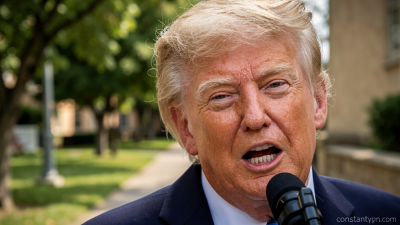
Trump Hints US Would Not Back UK Over Falklands
Constantvpn.com – Trump hints US would not back Britain in a renewed Falklands confrontation, Donald Trump told GB News, explicitly tying Washington’s military guarantee to what he framed as London’s failure to assist during the ongoing Iran campaign. The president’s remarks inject fresh uncertainty into a sovereignty standoff that has simmered between Britain and Argentina for more than four decades.
The timing sharpens the stakes. Argentine President Javier Milei is set to deliver a televised address Thursday evening in which he will reassert what he calls his country’s “historic” claim to the archipelago in the south-west Atlantic. Both governments now appear to be probing how far diplomatic patience can stretch before it snaps.
From Grievance Ledger to Alliance Test
Asked whether Washington would “come to the UK’s aid” in a fresh territorial clash, Trump recalled observing the 1982 conflict from the American side of the Atlantic.
“Well look, I was there when they had the first war. That was a long time ago and I watched it so carefully, and you comported yourselves very well. You took it back pretty strongly, but it’s a long way away.”
He then pivoted to the present-day Iran war, casting the UK’s perceived inaction as a breach of alliance solidarity. He noted that Britain draws a large share of its oil through the Strait of Hormuz yet offered no material support when asked.
“So, your country’s not doing well. Don’t forget, you get a big percentage of your oil from the Strait of Hormuz, and you weren’t there to help me. Your country was not there to help me. We didn’t need help, but I did ask Nato, and I asked your former leader, ‘why didn’t you send a couple of ships?'”
Trump said the then prime minister, Sir Keir Starmer, replied that no naval vessels were available for deployment — an answer the president labelled “pretty sad.” He broadened the rebuke across the alliance, observing that most NATO members funnel a substantial portion of their energy imports through the same waterway yet contributed nothing tangible.
“Nato was not there, even though they get – most of those countries get – a big portion of their oil from there. So we’re doing that by ourselves.”
Moments later, however, Trump walked back the implication of total self-reliance, stating his military did not require outside support. The oscillation between asserting independence and cataloguing perceived slights is a recurring feature of his public messaging.
A Sovereignty Posture the US Has Long Kept Deliberately Open
The diplomatic posture now under pressure has deep institutional roots. Successive American administrations since 1982 have formally recognised the United Kingdom’s de facto administration of the Falklands while refraining from taking a definitive position on ultimate sovereignty. That calibrated ambiguity was designed to keep Buenos Aires at the negotiating table and to avoid alienating a major South American partner.
Trump’s earlier suggestion — offered in response to a BBC question about whether Washington was “reviewing” its stance — that the US might revise its neutral position if London failed to raise defence spending already signalled a willingness to instrumentalise the issue. His latest comments push that logic further, conditioning military backing on perceived loyalty in unrelated theatres. When pressed directly, he offered only: “I always review every position. That’s just one of many.” The deliberately open-ended reply gave Argentine diplomats room to interpret the ambiguity in their favour.
The 1982 War in Numbers
The conflict Trump invoked was brief but devastating. Argentine forces landed on the islands in April 1982 to assert a territorial claim. A British task force sailed south, and seventy-four days of fighting followed. The toll: 255 British military personnel killed, three civilian islanders among the dead, and 649 Argentine military personnel lost. The war reshaped British defence policy and left a wound in Argentine national memory that Milei’s government continues to cultivate rhetorically.
The UK government moved quickly to reaffirm its position. A spokesperson stated that Falkland islanders “are British with a right to determine their own future” and added that the islanders have repeatedly expressed their wish to remain under British sovereignty.
FAQ
Why is Trump linking the Falklands to the Iran war? He framed the UK’s decision not to deploy naval vessels to support the Iran campaign as a failure of alliance solidarity, then suggested that Washington’s willingness to back London in a future Falklands confrontation depends on how reliably the UK has honoured its obligations as an ally.
What is the US’s official position on Falklands sovereignty? Since 1982, successive administrations have recognised British de facto administration while deliberately avoiding a definitive ruling on ultimate sovereignty, a stance designed to keep Argentina engaged diplomatically. Trump’s recent remarks suggest that posture may be revisited, though no formal policy change has been announced.
What does Milei’s Thursday address change? It is expected to restate Argentina’s “historic” claim to the archipelago in televised form. It does not, by itself, alter the legal or diplomatic status quo, but it signals Buenos Aires’ intention to keep the sovereignty question publicly alive.
Could the US actually withhold military support? No treaty or standing commitment obligates Washington to defend the Falklands. The islands fall outside NATO’s collective-defence umbrella, so any US backing would remain discretionary — which is precisely the leverage Trump’s remarks exploit.