
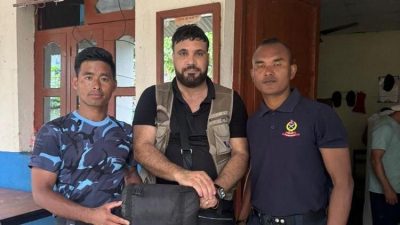
Aid Volunteer in Nepal Mistaken for Flood Survivor After Helicopter Return
Constantvpn.com – When Alastair Chambers stepped out of a humanitarian helicopter near the Trishuli river valley last week, he was heading into one of the most devastating natural disasters in Nepal’s modern history. Flash floods that swept through the country and into neighbouring Tibet had already claimed more than 1,000 lives, with approximately 3,900 people still unaccounted for. What the 45-year-old Gloucester-born volunteer did not anticipate was that his own return flight to Kathmandu would trigger a bureaucratic mix-up casting him as one of the rescued survivors.
Chambers, a former local councillor who had flown to Nepal specifically to assist communities cut off by collapsed bridges and landslides, found himself at the centre of a small media storm within hours of landing. Nepal’s authorities had announced that 119 people, including a British national, had been extracted through air operations. Chambers was that British national — or at least, that is what the paperwork suggested.
How the Confusion Unfolded
After completing his aid mission in a remote village, Chambers was flown back to the capital in a military helicopter. On arrival, he was deposited at army barracks where a police officer approached him and requested his personal details. The routine identification procedure, intended to comply with post-disaster protocols, was quickly misread by the officer as confirmation of a rescue operation.
“I got dropped off at the army barracks, and when I got dropped off one of the police officers came up to me and asked for my details. Then they presumed that I’d been rescued. It’s been a bit of a weird one, really.”
The error propagated rapidly. Within a few hours, Chambers fielded calls and messages from roughly fifteen journalists, each wanting to know how he was feeling after being pulled from the floodwaters. His response to each was essentially the same: he had not been rescued because he had never been in danger to begin with.
“News spreads — I was contacted by about 15 different journalists in the last few hours, just asking how I was and how I’m feeling after being rescued, and I had to say: ‘Well sorry, I haven’t been rescued.'”
Eight Hours Where One and a Half Should Suffice
The journey that brought Chambers into the disaster zone was itself a measure of how thoroughly the floods had shattered Nepal’s infrastructure. A helicopter route from Kathmandu to the affected Trishuli valley area normally takes around ninety minutes. On the day he flew in, the combination of debris-strewn corridors, low visibility, and damaged landing points stretched the transit to between eight and nine hours.
Once on the ground, conditions remained volatile. Chambers described navigating through areas where landslides had buried roads and fallen trees blocked every approach. During one operation, a sudden surge of floodwater forced his small team to climb uphill for safety.
“Thankfully, it wasn’t large as the other torrent of water, so we waited until that settled and then made our way down and helped locate bodies and deliver humanitarian aid for the last few days.”
His volunteer group distributed sleeping bags, water purification equipment, food supplies, and other essentials to villages whose only road links had been destroyed. The work, Chambers acknowledged, was physically demanding and emotionally taxing, but he described it as deeply rewarding.
“It’s been quite challenging, but it’s been very rewarding as well.”
Political Response and Diplomatic Engagement
While Chambers dealt with the practical aftermath of the floods, Westminster tracked the situation through formal channels. On Tuesday, Lord Wood of Anfield, Under-Secretary of State at the Foreign Office, briefed the House of Lords on the British nationals affected. He confirmed that 36 UK citizens remained unaccounted for, an increase from the previous figure of 33. The Foreign Office has been approached for further comment.
Minister for the Indo-Pacific Baroness Winterton is scheduled to travel to Kathmandu from Wednesday through Thursday to coordinate recovery support. During the two-day visit she will hold meetings with Nepali government officials, United Nations representatives, British embassy personnel, and members of the UK’s rapid deployment team currently assisting families of affected British nationals.
In London, Foreign Office minister Stephen Doughty will sit down with members of the British-Nepali community on Wednesday to outline the consular and welfare support available to those whose relatives are missing or displaced.
What Comes Next for Chambers
Despite the absurdity of being treated as a rescued survivor, Chambers’s focus remains on the village he helped reach. He intends to fly back to the United Kingdom to organise fundraising for the devastated community, then return to Nepal with additional supplies. Among his specific plans is the installation of solar-powered lighting systems for households that lost grid electricity when infrastructure was destroyed.
The episode, while mildly comic in its mechanics, underscores a broader reality: in the chaos following a catastrophe of this scale, the line between rescuer and rescued can blur in ways that no protocol fully anticipates. For the communities still waiting for their own families to be found, the distinction matters enormously — and the work of locating the missing continues.
Related Reading
Frequently Asked Questions
What is UK aid worker says he was mistaken?
UK aid worker says he was mistaken is the main topic of this guide. The article explains the context, practical details, and next steps readers should understand.
Why does UK aid worker says he was mistaken matter?
UK aid worker says he was mistaken matters because readers are looking for a useful answer, not just a short summary. Good content should match search intent and help them decide what to do next.