
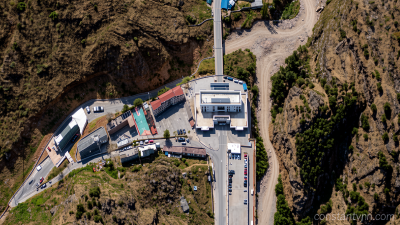
Seconds of Footage Expose the Full Fury of a Borderland Flood
Constantvpn.com – A clip lasting barely a handful of seconds has become the defining visual record of one of the deadliest flash floods in recent Himalayan history. Captured by a fixed surveillance camera at Gyirong, on the Tibetan side of the Nepal-China frontier, the footage carries a timestamp of 10:59:53. What begins as a dark, cloud-like mass cresting behind the rooftops quickly resolves into something far more terrifying: a churning wall of water, mud, shattered ice, and boulders tearing down the valley floor at terrifying speed. Within moments, structures that had stood for decades simply cease to exist.
For thousands watching the clip spread across social platforms, it was the first unambiguous confirmation of how catastrophic the event had truly been. Reconstructing the precise sequence of events in the minutes that followed remains an exercise in piecing together fragments — satellite imagery, partial video clips, and the electronic logs of a border-crossing office that was itself nearly obliterated.
A Corridor Built on Unstable Ground
The stretch of land between Rasuwagadhi in Nepal and Gyirong in Tibet is far more than a checkpoint. It sits along one of the oldest and most consequential trade and pilgrimage corridors linking the Kathmandu Valley with the high plateau of western Tibet. Pilgrims bound for Mount Kailash, merchants hauling goods across the Himalaya, truck drivers, customs personnel, tourists, and permanent residents of the border villages all converge on this narrow valley floor.
Geologically, the terrain offers little margin for error. Ajay Dixit, a hydrologist based in Kathmandu, describes the area as inherently fragile: deep-cut gorges, rivers running at high velocity, and channels loaded with heavy sediment that can hurl enormous boulders downstream during heavy rainfall or glacial melt events. The Friendship Bridge spanning the border, the road network, and a hydropower substation all sit within the floodplain’s reach, making them vulnerable to even a brief surge of meltwater or monsoon-driven runoff.
What the Records Reveal About That Morning
Nepal’s immigration department at the Rasuwagadhi post kept electronic logs of every transaction processed that day. The system recorded its final entry at 08:35:03 local time — equivalent to 10:52 on the Tibetan clock — fewer than ten minutes before the torrent became visible on the Gyirong camera. In total, 89 Nepali and foreign nationals had cleared immigration to depart for Tibet, while four individuals had registered their arrival into Nepal.
Among those 89 travellers were 32 Indian nationals, 12 Chinese citizens, nine Americans, and individuals holding passports from Britain, Canada, Australia, and Italy. India’s foreign ministry has since confirmed that at least 275 Indian citizens remain missing in Nepal, a figure that dwarfs the number captured in the immigration logs and suggests many more were in the corridor without having processed formalities that morning.
The Only Surviving Voice from the Office
Tika Ram Pokharel, a senior immigration assistant at Rasuwagadhi, happened to be in Kathmandu that day, sitting for an examination. He was the sole staff member to walk away from the disaster. Speaking about the morning’s events, he offered a rare first-person window into the final hours before the water arrived.
“This is a historic travel route between Kathmandu and Tibet,” explains Kathmandu-based hydrologist Ajay Dixit. “The area is geologically vulnerable, characterised by deep gorges and steep rivers that flow at high velocity, carry heavy sediment and can bring down huge boulders.”
Pokharel says the immigration office, located at Ghatte Khola Bazar roughly 1.5 kilometres north of the small trading settlement of Timure, opened at 08:00. By 08:20, when he telephoned a colleague on duty, he was told the crossing was exceptionally busy. Between 300 and 400 people were queued to depart for Tibet, while additional travellers arriving from the Chinese side were also present in the area.
“Those who completed the immigration formalities that morning, I don’t think were able to complete their immigration process on the Chinese side,” Pokharel says.
The walk from the Nepalese office to the Friendship Bridge took 15 to 20 minutes. Groups travelling together, or passengers arriving by bus, frequently waited for every member of their party to finish processing before moving as a unit. Those who arrived late the previous afternoon sometimes had to hold until the border reopened the following morning. These behavioural patterns make it extraordinarily difficult to pinpoint exactly where each of the 89 logged individuals stood when the flood struck.
Human Cost and the Search That Continues
Four immigration employees, including the head of the Rasuwagadhi office, were swept away. His body was later recovered far downstream. The female official who had keyed in the final transactions of the morning remains unaccounted for. Along with them, the flood destroyed the Friendship Bridge, severed road links, and carried away vehicles parked in the commercial strip between the immigration office and the crossing.
The satellite imagery taken in the aftermath shows a valley floor that had been densely packed with buildings, shops, and hotels reduced to a scarred expanse of debris. The scale of what vanished in under ten minutes — infrastructure, livelihoods, and hundreds of lives — underscores how little warning a high-mountain corridor can offer when the monsoon meets glacial melt in a narrow, sediment-choked channel. For the families still waiting, and for the governments coordinating a cross-border search across one of the world’s most remote frontiers, the answer to where those people were in their final moments may remain elusive for months.
Related Reading
Frequently Asked Questions
What is The final minutes before floodwater crashed?
The final minutes before floodwater crashed is the main topic of this guide. The article explains the context, practical details, and next steps readers should understand.
Why does The final minutes before floodwater crashed matter?
The final minutes before floodwater crashed matters because readers are looking for a useful answer, not just a short summary. Good content should match search intent and help them decide what to do next.