
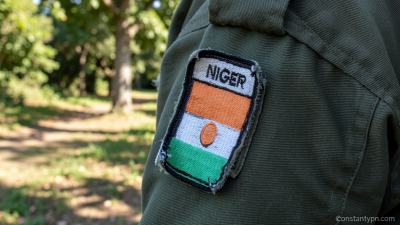
Niger’s Military Government Survives Mutiny as Russian Troops Play Central Role
Constantvpn.com – The Sahel’s latest chapter of instability unfolded in the early hours of a Saturday morning when gunfire and explosions tore through the streets of Niamey, Niger’s capital. What began as a mutiny at a major military installation quickly escalated into a full-scale attempt to overthrow the country’s ruling junta. Within hours, however, Nigerien authorities declared the uprising contained — and credited Russian servicemen with helping to break the back of the revolt.
The incident struck at two of the most symbolically important locations in the capital: the presidential palace and Air Base 101, a critical military installation embedded within the Diori Hamani airport complex. The base houses Nigerien military aircraft and drone units, hosts a joint counter-terrorism detachment operated under the Alliance of Sahel States, and also accommodates Russian and Italian military personnel stationed in the country.
Moscow Claims Credit for Repelling the Coup
On Sunday, Russia’s foreign ministry issued a statement confirming that elements of its African Corps had assisted Nigerien forces in driving back the mutineers. The ministry framed the intervention as part of a broader commitment to the region’s stability.
“Nigerien forces had repelled the attack with the assistance of servicemen of the African Corps of the Russian Ministry of Defence.”
The statement went further, pledging continued Russian backing for Niger’s campaign against what Moscow termed “extremists,” while insisting the situation had been restored to the control of what it called the “legitimate authorities headed by President [Gen Abdourahmane] Tiani.” The language was deliberate: Moscow was reinforcing its position as the security guarantor of a government that owes its very existence to a military takeover.
Context: A Region Locked Into Moscow’s Orbit
The attempted coup lands in a region where three neighbouring juntas — Niger, Mali, and Burkina Faso — have collectively severed longstanding defence partnerships with Western powers and pivoted toward Moscow. Russia’s African Corps, a relatively small but strategically placed formation, has become the backbone of security cooperation across all three states. In exchange for Russian military presence, training, and logistical support, the Sahel governments have aligned their foreign policy, economic negotiations, and even their media narratives with Kremlin interests.
Yet the bargain has not delivered the stability its architects promised. Jihadist insurgencies, fed by networks linked to both al-Qaeda and the Islamic State, continue to exact heavy tolls across the three countries. The very airbase where Saturday’s mutiny erupted had been struck twice earlier this year by jihadist forces — once by an Islamic State affiliate and later by an al-Qaeda-linked group — underscoring how thin the security margin remains even in the capital.
The Alliance’s Response and the Silence of the Junta
The Alliance of Sahel States, the trilateral bloc binding Niger, Mali, and Burkina Faso, issued a joint condemnation of the mutiny, describing it as:
“a betrayal by a group of soldiers involved in an attempt at destabilisation.”
Notably, neither the number of soldiers who participated in the revolt nor the casualty count has been made public. General Tiani, who assumed the presidency last year after deposing the country’s elected civilian leader, has not addressed the nation directly about the incident. Instead, the state broadcaster aired footage of several alleged mutineers being seized by members of the Presidential Guard, a visual meant to project control and finality.
Life in Niamey Returns to a Careful Normal
By Sunday, the Niger Press Agency reported that petrol stations, retail shops, and other commercial operations were reopening across the capital. Government supporters assembled in a central public square to voice backing for the security forces and for Tiani’s administration, a display of loyalty that also served as a signal to any remaining dissidents within the ranks.
Security forces, meanwhile, have stepped up patrols around sensitive locations in Niamey, including the main airport entrance and the presidential pavilion. The heightened posture suggests the junta views the mutiny not as an isolated flashpoint but as a symptom of deeper fractures within the officer corps.
What the Mutiny Reveals
For a government whose legitimacy rests entirely on military authority, an internal revolt carries a particular sting. It signals that the chain of command is not monolithic, that grievances — over pay, deployment, or political direction — can crystallise into action even in a junta that has already removed civilian oversight. The fact that Russian troops were needed to help restore order, rather than Nigerien units acting alone, adds another layer of complexity to a relationship already defined by dependence.
The Sahel’s three juntas entered their partnership with Moscow hoping to trade Western conditionality for unconditional military backing. Saturday’s events suggest that no amount of foreign firepower can fully insulate a fragile command structure from internal dissent. The question now is whether Niamey’s junta will treat the mutiny as a manageable hiccup or as a warning that the next challenge may come from within its own barracks.
Related Reading
Frequently Asked Questions
What is Russia says it helped to repel?
Russia says it helped to repel is the main topic of this guide. The article explains the context, practical details, and next steps readers should understand.
Why does Russia says it helped to repel matter?
Russia says it helped to repel matters because readers are looking for a useful answer, not just a short summary. Good content should match search intent and help them decide what to do next.