
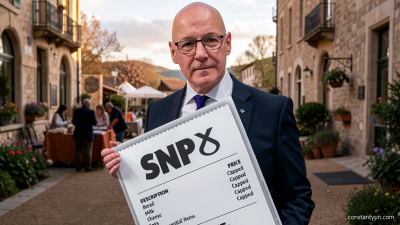
Scottish Industry Coalition Demands First Minister Abandon Food Price Cap Scheme
Constantvpn.com – A coalition of twenty-three Scottish business organisations has formally called on First Minister John Swinney to withdraw his proposed statutory cap on the retail prices of staple food and drink products, arguing the measure would fail to deliver any meaningful relief to households while distorting the market. The joint letter arrives just days before Swinney is scheduled to unveil his programme for government on Tuesday, placing the food-price question squarely at the centre of his early-term agenda.
The Government’s Rationale
The SNP’s election manifesto committed the party to compelling large supermarket chains to hold down the cost of what it described as “essential items” — specifically naming milk, eggs, cheese, and rice — as part of a broader cost-of-living response. Swinney has framed the intervention in public-health terms, stating that families were struggling to afford a basic weekly shop and that he carried a “public health responsibility” to ensure an affordable, nutritious diet remained accessible to all Scots.
The proposal would require legislative changes to the UK Internal Markets Act of 2020, the post-Brexit statute designed to prevent regulatory divergence and trade barriers between England, Scotland, Wales, and Northern Ireland. Amending that framework to insert a Scotland-specific price ceiling would represent a notable departure from the shared internal-market architecture established when devolved powers returned from the European Union.
Industry Pushback
The letter’s signatories span the full breadth of Scotland’s food and retail supply chain: retail, food and drink production, manufacturing, and distribution. Among the named organisations are the Scottish Retail Consortium (SRC), the Food and Drink Federation Scotland, Scottish Bakers, and Dairy UK. Collectively, they argue that a statutory price ceiling would not address what they identify as the “root causes of elevated food prices” — namely rising production inputs, refrigeration expenses, and distribution costs that have pushed wholesale prices upward across the sector.
Ewan MacDonald-Russell, deputy head of the SRC, made the case in blunt terms on the BBC’s Radio Scotland Breakfast programme:
“Price caps don’t tackle food price inflation. They are not a solution, they are a gimmick that sounds quite effective, but it just displaces cost elsewhere. We can’t see a single example of where this has worked.”
MacDonald-Russell pointed to Hungary as a cautionary precedent, describing how a price-cap policy there produced shelf shortages, displaced domestically produced goods with “cheap imports,” and generated friction between retailers and shoppers at the point of sale. He warned that the Scottish scheme would also place small independent shops — which would fall outside the proposed legislation’s scope — at a competitive disadvantage against larger chains subject to the cap.
“Scottish consumers benefit from the most affordable food prices in western Europe. We know food price inflation is a problem, but the best model to deal with it is the one we have right now and price caps are going to make that worse.”
He went further, suggesting the scheme could paradoxically raise the overall cost of a typical shopping basket, because the administrative burden of compliance and the economic distortion of the cap itself would ultimately be absorbed by businesses and passed through to consumers.
“It is giving a false promise that it is going to be able to help with something. In reality, there is as good a chance it is going to make the overall cost of a shopping basket higher, because the cost of the scheme as well as the cap have to be absorbed by businesses.”
Government Response and Next Steps
The Scottish Government has not signalled any intention to abandon the policy. A spokesperson reiterated that assisting households with the cost of living remained a “top priority” and confirmed that ministers had welcomed engagement with stakeholders, including retailers, food producers, and farmers, on the design of food price controls. A formal consultation is expected to launch shortly, inviting further views from across the sector before any legislative drafting proceeds.
Broader Context and Implications
The debate sits within a wider European conversation about how governments should respond to persistent food-price inflation that has outpaced general CPI in many markets since 2022. While some jurisdictions have experimented with temporary price controls or subsidy mechanisms, most Western European economies have relied on competition policy, supply-chain investment, and targeted household support rather than direct price ceilings. The Scottish proposal, if enacted, would place Scotland in a small minority among comparable markets.
For the 23 signatory organisations, the stakes extend beyond a single product category. They contend that intervening in the price of a handful of staples could trigger supply-chain reorganisation, encourage stockpiling behaviour, and create regulatory complexity that deters investment in Scottish food manufacturing. For households, the question remains whether a politically visible cap on four or five shelf items delivers tangible savings, or merely shifts the financial burden into less visible corners of the supply chain.
Swinney’s Tuesday programme for government will test whether the first minister treats the industry letter as a signal to recalibrate, or as a predictable lobbying exercise to be answered with a consultation process and a reaffirmation of the manifesto commitment. Either way, the food-price cap has become one of the defining early tests of his administration’s willingness to intervene directly in market pricing — a step that, if taken, would mark a significant shift in Scottish economic governance.
Related Reading
Frequently Asked Questions
What is Business groups urge Swinney to scrap?
Business groups urge Swinney to scrap is the main topic of this guide. The article explains the context, practical details, and next steps readers should understand.
Why does Business groups urge Swinney to scrap matter?
Business groups urge Swinney to scrap matters because readers are looking for a useful answer, not just a short summary. Good content should match search intent and help them decide what to do next.