
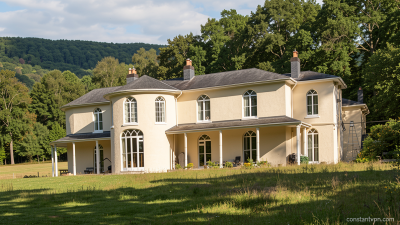
Ten Neighbours, One Georgian Mansion, and the Quiet Revolution of Shared Living in Mid Wales
Constantvpn.com – On the fringes of Llanidloes, a small town in Powys, a Grade II listed Georgian mansion sits amid fifteen acres of woodland and pasture. The kind of property that, on the open market, would command a price rivaling a modest two-bedroom flat in a major UK city. Yet the people who occupy its seven private flats and communal spaces did not inherit a fortune or win a lottery. They simply decided, collectively, that pooling resources and responsibilities made more sense than competing for individual ownership in an increasingly unaffordable housing market.
Dol-llys Hall, as the estate is known, has been inhabited for centuries. The current structure dates to the early nineteenth century, when Georgian architectural fashion swept through the Welsh countryside. Over the decades since, the building has cycled through roles as a stately residence, a school, and a care home before its present incarnation as a cooperative dwelling. What unites its current occupants is not wealth or lineage but a shared commitment to sustainable, communal stewardship of a large property that no single household could realistically maintain alone.
A Model Distinct from the Commune
The arrangement at Dol-llys is explicitly described by its residents as co-housing rather than a commune. Each of the seven flats has its own front door, its own kitchen, its own private living space. What is shared is the grounds, the communal rooms, the laundry facilities, the heating infrastructure, and the decision-making processes that govern the estate. Residents divide maintenance tasks, garden work, and administrative duties among themselves, rotating responsibilities so that no single person bears the full weight of keeping a fifteen-acre property functional.
This distinction matters to prospective members. Louise Robinson, one of the longest-serving of the ten current residents, was emphatic that the model preserves individual autonomy while offering collective support.
“You have got a ready-made village mentality where people just help each other out. There’s six other flats going ‘what can we do?’ And that means a lot.”
Robinson, who arrived in early 2020 after being made redundant from an insurance role in London, had been spending increasing time walking the Welsh countryside on weekends before deciding to relocate permanently. As a single person, she acknowledged that moving to a rural village alone would have been daunting. A friend’s casual mention of intentional communities prompted her research, and after evaluating several options she rejected arrangements where a resident would surrender all private space in exchange for communal living. Dol-llys offered what she called the right balance.
“We term ourselves as co-housing, because we all have our separate flats. We share the grounds, we share the common rooms, we share responsibilities and decision-making, but we all have our front doors, which I think is important to everybody who chooses to live here.”
Retirees Finding Purpose in Collective Stewardship
Ken O’Brien and Susan Lancaster, both seventy years old, joined the community a few months after Robinson. They had considered communal living decades earlier, when their children were young, but felt the timing was wrong. In retirement, the calculus shifted. What drew them was not merely the architectural character of the building or the expanse of its grounds, but the community’s track record. The cooperative dates to 1991; by the time Robinson arrived, one founding member had already been present for nearly three decades.
Ken, who had spent his youth in a religious community, evaluated several newer cooperative ventures before settling on Dol-llys. He noted that some alternatives suffered high turnover or imposed a rigid ideological framework. What he found at Dol-llys, by contrast, was stability and organisational maturity.
“It seemed mature, professional. People were organised. It was stable and well-run.”
Susan added that the building’s physical condition was sound, a practical consideration for a couple of their age. Ken framed the appeal in terms of shared purpose: growing food, maintaining the grounds, and building what he described as a degree of resilience against external shocks to supply and cost of living.
Younger Residents and the Search for Alternative Structures
Not all residents are retirees. Jemma, thirty-six, originally from Birmingham, and her partner Yiannis occupy the estate’s single rental unit. Their path to Dol-llys wound through several alternative-living experiments: first the Brithdir Mawr community in west Wales, where they met; then a houseboat; then another intentional community at Meifod, also in Powys. For them, the early-20s years of communal and semi-communal living were less about ideology than about access to role models and practical skills in permaculture, ecology, and self-sufficiency that conventional urban employment rarely afforded.
“As well as all the benefits from working on projects and having your home life be quite vocational, it can be very practical as well. It can be a way to have a better quality of life.”
Jemma now works in healthcare, commuting forty minutes to a larger town – a routine as unremarkable in rural mid Wales as a suburban commute elsewhere. Yiannis is a support worker. Several other residents hold current or former positions in health, education, and public-sector roles, suggesting that the community draws on professional skills while offering a living arrangement that conventional employment structures do not provide.
The Financial and Legal Framework
For those who are not renting, membership of Dol-llys operates on a loan-stock basis: residents contribute capital to the cooperative’s ownership structure and receive a share of the equity, rather than holding individual freehold titles to their flats. This arrangement keeps the building collectively owned and prevents any single unit from being sold off to an outside buyer who might disrupt the community’s cohesion. It also means that the fifteen acres of grounds, the communal infrastructure, and the decision-making protocols remain intact across generations of residents.
In a Welsh county where median house prices have climbed steadily and where rural isolation can make solo household management of large properties impractical, the Dol-llys model offers a pragmatic answer to two problems at once: affordability and the sheer labour of maintaining a historic building and its grounds. The residents do not frame their arrangement as utopian. They frame it as sensible, sustainable, and, in Louise Robinson’s words, a place where six other flats are always asking what they can do to help.
Related Reading
Frequently Asked Questions
What is We all share a 15 acre?
We all share a 15 acre is the main topic of this guide. The article explains the context, practical details, and next steps readers should understand.
Why does We all share a 15 acre matter?
We all share a 15 acre matters because readers are looking for a useful answer, not just a short summary. Good content should match search intent and help them decide what to do next.