
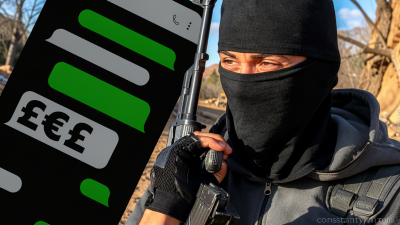
A WhatsApp Group Chat Exposed a Hidden Banking Network Moving Hundreds of Millions of Euros
Constantvpn.com – A single WhatsApp group of 532 members became the key to unraveling a sprawling underground cash-transfer operation that moved hundreds of millions of euros across borders with virtually no electronic footprint. The chat, titled “Traders of Greater Europe,” coordinated payments for clients spanning continents, with destinations including Birmingham, London, and detention camps in Syria where families of Islamic State fighters were held. The revelation emerged from a European Broadcasting Union (EBU) investigative journalism inquiry that traced the group’s role in financing organised crime, extremism, people smuggling, and drug trafficking.
How the Chat Was Discovered
The trail began in Belgium, where investigating magistrate Vincent Guerra was probing a terror-financing case. What started as a narrow inquiry into funds flowing to militants quickly expanded into something far larger. Guerra described the volume of transactions as “staggering” and said the network’s reach covered “the entire planet.”
“It became just a drop in the ocean of transactions,” Guerra said.
The breakthrough came when Belgian police arrested Abu Adam, identified as the Brussels-based head of the network, along with his deputy, Abu Ahmed. A 2024 Belgian court subsequently convicted six money launderers connected to the operation. During the arrest of Abu Adam, officers found the Traders of Greater Europe group chat stored on his phone. Guerra compared the discovery to “hitting the jackpot,” saying it exposed the internal mechanics of a vast, unregulated financial system operating beneath the surface of the formal banking world.
The Scale of the Operation
The chat contained more than 82,000 messages exchanged between late February and December 2022. Members communicated in Arabic to arrange cash payments through the centuries-old hawala system. The group was reserved for transfers exceeding €5,000 (approximately £4,279), though many individual payments were substantially larger. Guerra noted there was no evidence that every participant in the chat was directly involved in moving criminal money; the group likely included legitimate traders and brokers alongside those linked to illicit activity.
Abu Adam’s phone also held 6,000 photographs of €5 banknotes showing their serial numbers, alongside 6,000 photographs of identity cards. In hawala transactions, these details serve as unique reference codes linking sender to recipient. Guerra calculated that the sheer volume of notes and IDs implied Abu Adam had personally processed at least 12,000 transactions.
“This isn’t just amateur work; it’s professional, and at a level we could never have imagined. They’re bankers with no government oversight.”
Understanding Hawala
Hawala is an ancient remittance mechanism predating modern banking. It relies on a web of trusted intermediaries called hawaladars, typically operating in different cities or countries. A sender hands cash to a local hawaladar, who then instructs a counterpart in the destination city to release the equivalent amount to the recipient, minus a commission. The two brokers reconcile their accounts at a later date. No physical banknotes cross borders, and no electronic transaction record is generated in the conventional sense.
The system has long served legitimate purposes. Migrant workers in countries with limited banking infrastructure have relied on hawala to send support home to families. However, its opacity makes it attractive to those wishing to sidestep the SWIFT messaging network that underpins most international wire transfers. Under SWIFT, banks are obliged to flag unusually large payments and report suspicious activity to regulators. Hawala, by contrast, leaves no such trail for authorities to follow.
The Islamic State Connection
Among the most striking findings was evidence that payments routed through the Brussels node of the network reached Islamic State militants in Syria. Belgian police established that the convicted defendants had been sending money specifically to help wives of IS fighters escape from detention camps in the country. This linked the chat directly to a global counter-terrorism concern, showing how informal cash channels can sustain extremist organisations even after their territorial caliphate collapsed.
Wider European Reach
The EBU investigation did not stop at the Traders of Greater Europe group. Reporters identified additional gangs across Europe exploiting hawala structures for criminal purposes, including people smuggling and narcotics trafficking. One former money launderer, whom the investigation team refers to as Frank, described being involved in transactions totalling several hundred million euros. He recalled his first exposure to the system at an office in a small town outside Rotterdam, where five or six couriers arrived within roughly an hour and a half, collectively moving at least one million euros in cash.
Legal Status and Regulatory Gaps
Hawala operates outside formal banking regulation in most European Union member states, where it is effectively illegal unless brokers hold appropriate licences. In the United Kingdom, however, the system is lawful provided the brokers register with HM Revenue & Customs. This patchwork of national rules creates jurisdictional blind spots that underground networks can exploit. The Belgian case underscores how a single phone, a single group chat, and a single magistrate’s persistence can illuminate a financial infrastructure that governments have struggled to map for decades.
The implications extend beyond any one country. If informal remittance channels of this scale can move funds to extremist groups, smugglers, and drug dealers without triggering a single automated alert, the question for European regulators is not merely how to prosecute the individuals involved, but how to build oversight capable of seeing the entire network before the next WhatsApp chat goes silent.
Related Reading
Frequently Asked Questions
What is WhatsApp chat used to send cash?
WhatsApp chat used to send cash is the main topic of this guide. The article explains the context, practical details, and next steps readers should understand.
Why does WhatsApp chat used to send cash matter?
WhatsApp chat used to send cash matters because readers are looking for a useful answer, not just a short summary. Good content should match search intent and help them decide what to do next.