
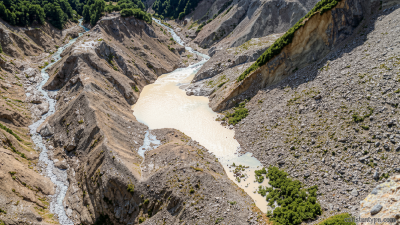
Second Flood Threat Looms as Barrier Lake Overflows Near Nepal-Tibet Border
Constantvpn.com – Chinese authorities have issued an urgent warning that a newly formed barrier lake, sitting just upstream of the zone devastated by Wednesday’s catastrophic flash flood, faces a “high risk” of breaching its natural dam and unleashing a second wave of destruction downstream. The alert lands in the most vulnerable moment possible: rescue crews are already stretched thin, hundreds remain unaccounted for, and heavy rainfall continues to pour into the region.
What Triggered the Original Disaster
Scientists have concluded that Wednesday’s flood was almost certainly set in motion when a section of glacier near Langtang Lirung — one of the highest peaks in the Himalayan range — broke free and plunged into the river valley below. The sudden influx of ice and meltwater generated a massive surge that swept downstream, carrying enormous quantities of water, rock, and debris in its path. The force of that surge struck Gyirong Port, the principal overland crossing between Nepal and China, and communities on both sides of the border.
Glacier-collapse events of this magnitude are rare but increasingly studied as mountain glaciers respond to warming temperatures. When a large ice mass detaches and impacts a river channel, the resulting outburst flood can release millions of cubic metres of water within minutes, overwhelming anything downstream that has not been engineered to absorb such a volume.
The Barrier Lake: Mechanics and Current Status
The landslide debris left behind by the initial collapse has dammed the river at the confluence of the Chhochen Khola and Purepu Tsangpo, creating what hydrologists call a barrier lake — a reservoir held back not by concrete or earthworks, but by a chaotic pile of rock, soil, and ice. As of Friday morning, state broadcaster CCTV reported that roughly 2.5 million cubic metres of water had already pooled behind the natural dam. Officials projected that an additional volume bringing the total to three million cubic metres would flow into the basin between Thursday and the weekend.
China’s Ministry of Water Resources confirmed the lake had begun to overflow its banks. Combined with persistent heavy rain in the catchment, the situation has prompted engineering teams to deploy on-site, tasked with continuous monitoring of water levels, dam integrity, and local atmospheric conditions.
“High risk of breach.”
That phrase, used by officials describing the weekend outlook, carries particular weight given the lake’s position: it sits several kilometres upstream of Gyirong Port, in the same corridor where the original surge already proved lethal. A failure of the debris dam would send a fresh pulse of water and sediment racing toward the very communities still reeling from Wednesday’s event.
Rescue Operations Halted
The compounding danger has forced a painful operational decision. A CCTV report broadcast Friday morning stated that most Chinese emergency services were immobilised at a village approximately seven kilometres (four miles) from Gyirong Port, unable to advance because the barrier lake was “overflowing non-stop,” creating conditions ripe for fresh flooding or secondary debris flows. Search and rescue operations near the Nepal-Tibet border were suspended as a result.
On the Tibet side of the border alone, more than 550 people remain missing — nearly half of them foreign nationals. Across Nepal, several hundred have been confirmed dead, with hundreds more still unaccounted for. The suspension of rescue work, however necessary, extends the window in which survivors in debris fields may lose their chance.
Wider River Risks in Nepal
The threat is not confined to the immediate border zone. Nepali authorities have separately warned that debris blockages elsewhere in the mountain drainage network could trigger additional flood events along the Bhote Koshi and Trishuli rivers. Residents in the valleys below those waterways have been urged to keep clear of riverbanks until the danger passes. The Bhote Koshi, in particular, drains the Langtang valley system and has historically been prone to glacial lake outburst floods, making the current debris-laden conditions especially hazardous.
Why This Matters Beyond the Immediate Crisis
The sequence of events — glacier collapse, outburst flood, secondary barrier-lake formation, overflow under rainfall — illustrates a compounding risk pattern that mountain communities across the Himalaya face with growing frequency. Each stage amplifies the next: the initial surge deposits debris that dams the river; the dammed river accumulates water; rainfall adds volume; and the resulting overflow or breach delivers a second, sometimes larger, pulse downstream. Engineering teams monitoring the Chhochen Khola–Purepu Tsangpo confluence are, in effect, watching a live demonstration of that cascade.
For the people of Gyirong Port and the villages along the border corridor, the coming weekend represents a narrow window in which the lake either stabilises, drains gradually, or fails catastrophically. The decision to hold rescue crews at seven kilometres’ distance is a calculation of risk against risk: send them forward and they may be swept away by the very event they are trying to mitigate. Hold them back and the missing remain missing longer. Either way, the mountain is deciding the terms.
Related Reading
Frequently Asked Questions
What is High risk of lake breaching and causing?
High risk of lake breaching and causing is the main topic of this guide. The article explains the context, practical details, and next steps readers should understand.
Why does High risk of lake breaching and causing matter?
High risk of lake breaching and causing matters because readers are looking for a useful answer, not just a short summary. Good content should match search intent and help them decide what to do next.