
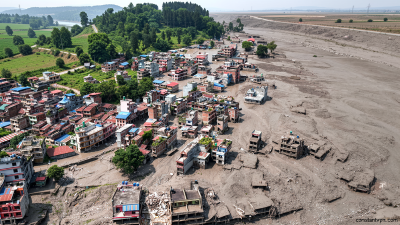
Nepal’s Border Villages Erased by Mud Torrents That Mimicked an Earthquake
Constantvpn.com – On Wednesday, a wall of mud and water so violent that seismologists mistook it for seismic activity tore through settlements along the Nepal–Tibet border, killing more than 175 people and leaving roughly 800 unaccounted for. Entire hamlets in the high Himalayan corridor were flattened in minutes, and by Thursday rescuers were wading through knee-deep debris, trying to reach survivors trapped beneath collapsed structures. The scale of destruction has overwhelmed local emergency services, and Nepalese authorities have scrambled aid convoys and relief supplies toward the hardest-hit zones.
The confusion between a flood and a quake underscores just how extreme the event was. In a region where earthquakes are a recurring threat, the initial ground-shaking and roar of displaced earth triggered seismic alerts before meteorologists confirmed the true cause: a catastrophic flash flood, likely fed by intense monsoon rainfall saturating already unstable slopes above the villages.
A Mother’s Account of Watching Her Family Vanish
Kalpana Malla, a resident of Nuwakot district, described the moment the torrent reached her home. She watched as the current swallowed her father, her mother, her sister, and her sister’s children in a single, unstoppable surge.
“My family members were swept away by the flood in front of my eyes,” Malla said. “They could not escape the flood; there was no chance at all. This flood took everything, but my son and I climbed the rooftop of a house and survived but couldn’t explain how.”
Her son, Sugam Malla, credited a single act of desperation with saving his mother’s life. He grabbed her hand and hauled her upward as the water rose around them. Before the flood struck, he had handed his mobile phone to his sister so she could maintain contact with relatives. Hours later, the number went silent.
“I am worried she must be swept away,” he said.
Agriculture Wiped Out Alongside Lives
For farming families in the border districts, the disaster extends far beyond human casualties. Goma Pandit, another survivor, catalogued the material annihilation in her village: every buffalo, every head of cattle, gone. Her cultivated plots were buried under layers of silt and rock.
“My farmland is also swept away. Ten sacks of mustard seeds, tons of corn and rice paddy are all gone. Nothing is left.”
Losses of this kind can push already marginal mountain households into prolonged food insecurity, particularly when the next planting season is weeks away and replacement seed stock is scarce in remote valleys.
Hours of Uncertainty at Kathmandu’s Teaching Hospital
At TU Teaching Hospital in the capital, corridors filled with relatives of the missing, many of whom had been stranded overnight in makeshift camps of blankets and plastic chairs. The waiting is its own ordeal: no confirmed body means no closure, and every unanswered phone call prolongs the agony.
Ram Khumari Shrestha held up her handset to show a photograph of her husband, a commercial driver who had been en route to Rasuwa when the flood hit.
“This is my husband. He was off to Rasuwa as a part of his driving job. He was in contact with me until 8 pm yesterday. But I couldn’t call him this morning. The phone was switched off,” she said.
Mani Shrestha Bishwa had been camped outside the hospital since Wednesday evening, hoping for word from his younger brother, a cousin, an uncle, and a close friend. His last confirmed contact with all four came at 8:30 in the morning, before the waters rose.
The Man Who Missed It by an Hour
Trekking guide Sonam Dorjee departed his home village of Rasiwa Syafru at 08:00 local time on Wednesday, heading toward Kathmandu. The flood struck roughly an hour after his departure. Driving south, he heard over the radio the roar of water inundating the valley behind him.
“It [sounded] like an earthquake,” Dorjee recalled. “My house has collapsed… I have seen a photo.”
His sister, Dechen Tamang, was inside the village when the torrent arrived. She is missing along with her husband and several other relatives. Dorjee described the event as “sudden and devastating” and urged that survivors still trapped need immediate evacuation, temporary shelter, food, and medical attention.
“There is a 10% chance, we hope,” he said, of finding his sister alive.
Why This Region Is So Vulnerable
The Nepal–Tibet border corridor sits at the junction of the Himalayan orogenic belt and the monsoon system. Steep, glacially carved valleys channel meltwater and rainfall into narrow gorges with little room for dispersion. Villages built on alluvial fans at valley mouths face a compounding risk: heavy summer rains saturate upper slopes, while permafrost thaw accelerates slope failure. Infrastructure in these remote settlements is sparse, and evacuation routes are often single-track mountain roads that become impassable within minutes of a major flood event.
With over 800 people still unaccounted for and rescue operations hampered by ongoing mudflows and damaged access roads, authorities face a race against both time and weather. Monsoon systems remain active across the region, and forecasters warn that additional heavy-rain episodes could trigger secondary landslides in already destabilized terrain, complicating search-and-rescue efforts for days to come.
Related Reading
Frequently Asked Questions
What is The flood took everything?
The flood took everything is the main topic of this guide. The article explains the context, practical details, and next steps readers should understand.
Why does The flood took everything matter?
The flood took everything matters because readers are looking for a useful answer, not just a short summary. Good content should match search intent and help them decide what to do next.