
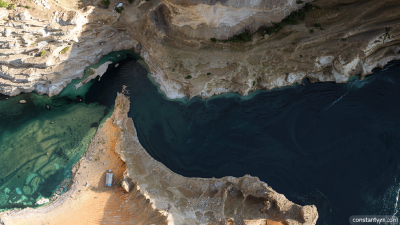
US Navy Declares Strait of Hormuz Free of Mines as Energy Markets Brace for Next Move
Constantvpn.com – The critical waterway linking the Persian Gulf to the open ocean has, according to Washington, been swept clean of naval mines. US President Donald Trump announced that American naval forces have either removed or detonated every mine laid in the Strait of Hormuz, effectively reopening the corridor that Iran had kept largely shut since hostilities erupted in the Middle East. The declaration lands at a moment when global oil traders are still digesting weeks of volatile price swings triggered by the strait’s closure.
“Iran has been notified that any ship or boat placing new mines will be immediately and systematically destroyed,” Trump wrote on his Truth Social platform.
Tehran has offered no public response to the claim. The silence is notable given that Iranian forces have, in recent weeks, opened fire on vessels they say attempted to transit the passage without Tehran’s authorization — a practice that directly contradicts the long-standing international-law position that the strait constitutes international waters through which all shipping may pass unimpeded.
Why the Strait Matters
Before the conflict began, roughly one-fifth of the world’s oil and liquefied natural gas flowed through the Strait of Hormuz each day. Tanker operators, refineries, and commodity traders built their logistics around that steady throughput. When Iran moved to close the waterway, the disruption rippled through futures markets almost instantly, producing the kind of wild price oscillation that has kept energy desks on edge for weeks. The strait’s narrowest point is barely a few kilometres wide, making it one of the most strategically concentrated chokepoints on the planet — and one that no single nation can block indefinitely without inviting a military response.
How the War Started and Escalated
The present conflict traces back to 28 February, when US and Israeli aircraft struck targets inside Iran. Tehran retaliated swiftly, directing fire not only at Israeli positions but also at American military installations across the region and at US Arab allies in the Gulf. A ceasefire was subsequently arranged to create space for negotiations aimed at ending the fighting, but that truce has since collapsed. Sporadic exchanges of fire between American and Iranian forces continue, and the diplomatic track has stalled.
The MoU, Its Expiry, and the New Sanctions Package
In June, Washington and Tehran signed a Memorandum of Understanding — a fourteen-point document that set a sixty-day window for the two sides to reach an arrangement governing the Strait of Hormuz, after which substantial negotiations on the nuclear question were to follow. The nuclear track centres on allegations that Iran is building a nuclear weapon, a claim Tehran has consistently rejected. That sixty-day deadline has now lapsed without a deal, and the talks have broken down.
This week the US Treasury unveiled a sweeping package of economic sanctions aimed at Iran. Secretary Scott Bessent warned that any country choosing to partner financially with Tehran would face isolation from Western-led financial networks. Trump has framed the measures as a path toward the collapse of the Iranian regime itself — a bet its leaders are openly contesting.
Iran has lived under some form of sanctions for most of the decades since the Islamic Republic was founded in 1979. Economy Minister Ali Madanizadeh told reporters that Tehran was “fully prepared” for the expanded restrictions and predicted they would amount to “another defeat” for the United States. Yet the war’s toll, compounded by a US naval blockade of Iranian ports maintained for weeks to choke off trade, has taken a visible bite out of an already strained economy.
China Steps Into the Fray
Beijing, the largest single buyer of Iranian crude, moved quickly to register its opposition. On Tuesday the Chinese government declared itself “firmly opposed” to what it labelled Washington’s “illegal unilateral sanctions” and vowed to take “all necessary measures” to protect its commercial rights. The timing sharpens the stakes: Trump and Chinese President Xi Jinping are scheduled to meet next month, and Washington is expected to weigh carefully how aggressively it presses the sanctions line without provoking a tit-for-tat response from a capital that processes the majority of the world’s rare-earth elements and other critical minerals essential to high-tech manufacturing. Beijing has already tightened export controls on rare earths during earlier trade negotiations, giving it a proven lever it could pull again.
The Question of Who Controls the Strait
Underneath the sanctions and the mine-clearing announcements lies a deeper dispute: who governs passage through the Hormuz. Iran has signalled that it wants full administrative control of the waterway — a position the United States and most other maritime nations reject, insisting the strait remains international waters where transit must stay free, as it was before the war.
Until recently, and operating within the framework of the June MoU, Iran had been in talks with Oman — a US ally bordering the strait’s southern shore — to agree a joint mechanism for administering the passage. Those negotiations have not yet produced an agreement. Last week Trump went further, threatening to bomb the Omani capital “if it gets in the way” of his administration’s own bilateral talks with Iran over the issue. Whether the Iran-Oman channel is still open, now that Washington has shifted to a new phase of the conflict, remains unclear.
For the global energy sector, the practical question is whether the mine-clearing announcement translates into a sustained return of tanker traffic or merely a temporary lull before the next round of hostilities. Until the underlying dispute over sovereignty, transit rights, and nuclear capability is resolved, the strait will remain the single most consequential flashpoint in world energy logistics.
Related Reading
Frequently Asked Questions
What is Trump says all mines cleared?
Trump says all mines cleared is the main topic of this guide. The article explains the context, practical details, and next steps readers should understand.
Why does Trump says all mines cleared matter?
Trump says all mines cleared matters because readers are looking for a useful answer, not just a short summary. Good content should match search intent and help them decide what to do next.