
Wave of Arson Strikes Thailand’s Restless South as Insurgency Flares Again
Constantvpn.com – Over fifty coordinated fires and incendiary strikes swept through Thailand’s southern border provinces in a single night, according to the military’s Internal Security Operations Command. The attacks, which unfolded between 20:00 local time (13:00 GMT) and midnight on Saturday, were described by officials as deliberate operations designed to sow disorder in a region already strained by decades of low-intensity conflict.
At least two people sustained injuries in the barrage. A convenience store, a local government administrative office, and a stolen vehicle were among the structures reduced to smoldering wreckage. Telecommunication towers were targeted at multiple sites, disrupting communications in the affected districts. Security personnel urged residents to avoid handling any unfamiliar objects left near blast zones.
Injuries and the Overnight Curfew
The most serious casualty reports came from Muang district in Narathiwat province, where two women were wounded when an explosive device detonated. The military statement noted that the majority of incidents were concentrated in Narathiwat, with additional strikes registered in the adjacent provinces of Yala and Pattani.
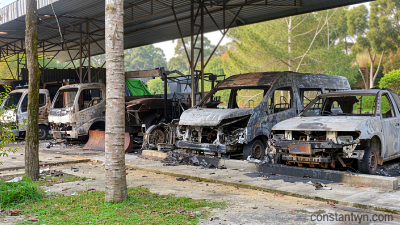
Authorities imposed an overnight curfew across Narathiwat province following the attacks. The restriction was lifted on Sunday morning, and no further incidents had been recorded by that point. Charred vehicles were photographed parked outside an administrative office in the province, underscoring the scale of destruction in a single night.
No faction or armed group has publicly claimed responsibility for the coordinated operation.
A Conflict That Has Never Truly Ended
The southernmost provinces of Thailand — Narathiwat, Yala, Pattani, and parts of Songkhla — have been the theater of a persistent insurgency since 2004. In a country where Buddhism holds cultural and political dominance, these provinces are home to a substantial Muslim population that has long pressed for greater self-governance. More than 7,000 people have lost their lives in the violence over the past two decades, making it one of the longest-running internal conflicts in Southeast Asia.
The insurgency is principally directed by the Barisan Revolusi Nasional (BRN), a coalition of separatist factions. Since 2013, a peace process brokered by Malaysia has attempted to bring both sides to a durable agreement. Yet the talks have stalled repeatedly, undermined by shifting governments in Bangkok and by internal fractures within both the insurgent ranks and the Thai state apparatus.
In July of this year, five soldiers were killed in a combined gun-and-bomb ambush at a checkpoint in Narathiwat. That incident prompted the authorities to postpone a planned round of dialogue, deepening skepticism about whether a negotiated settlement remains achievable.
Targeting State Symbols
Thai media have noted a pattern in which insurgents select security personnel and government installations as targets, sometimes timing strikes to coincide with official visits to the region. The Saturday night operation — hitting administrative offices, commercial premises, and communications infrastructure simultaneously — fits that pattern of symbolic disruption aimed at projecting state weakness.
Political Stakes: The Prime Minister’s Visit
The timing of the attacks carries particular weight given that Thai Prime Minister Anutin Charnvirakul and members of his cabinet are scheduled to travel to Hat Yai, the commercial hub of southern Songkhla province, for a two-day visit next week. The itinerary includes discussions on investment projects, flood-prevention measures, and regional security. A fresh wave of violence so close to a high-profile government trip raises questions about whether the visit will proceed as planned and what signal its continuation — or cancellation — would send to communities already living under the shadow of periodic insurgency.
For residents of the southern provinces, each new episode of coordinated violence reinforces a familiar anxiety: that the peace process, whatever its formal status, has not translated into daily safety. The curfew lifted on Sunday morning, but the charred shells of vehicles and the silence of burned-out towers will remain visible reminders for weeks.
Related Reading
Frequently Asked Questions
What is Dozens of co ordinated arson attacks?
Dozens of co ordinated arson attacks is the main topic of this guide. The article explains the context, practical details, and next steps readers should understand.
Why does Dozens of co ordinated arson attacks matter?
Dozens of co ordinated arson attacks matters because readers are looking for a useful answer, not just a short summary. Good content should match search intent and help them decide what to do next.