When the Thermometer Outpaces the Timetable: UK Schools Face a New Thermal Reality
Constantvpn.com – The summer of 2025 is shaping up to be the hottest ever recorded in Britain, and the consequences are landing squarely on the desks of millions of schoolchildren. Five widespread heatwaves struck the country this year, and four consecutive months pushed temperatures past 35°C — a streak with no precedent in the national record. For educators, parents, and policymakers, the numbers translate into a single, uncomfortable question: can the traditional school calendar survive the summers that climate change is now delivering?
A Calendar Built for a Cooler Century
Scotland’s pupils returned to their playgrounds in mid-August after a break that opened in late June or early July. Across much of continental Europe, the academic rhythm follows a broadly similar template. But in England, Wales, and Northern Ireland, the timetable runs differently: schools did not release children until late July, meaning that the worst of the early-summer heat hit classrooms while exam boards were already in full swing. The result was chaotic. More than 1,000 schools across the UK either shut their doors for the day or sent pupils home early, before the afternoon peak made conditions untenable.
Inside those buildings, the experience was far worse than the thermometer outside suggested. With no air conditioning and ventilation systems designed for a milder climate, classrooms became stifling. GCSE and A-level candidates, already under enormous pressure, found themselves attempting high-stakes examinations in rooms that felt like ovens. The disruption was not a minor inconvenience; it was a direct assault on learning outcomes.
“We know high temperatures can significantly impair concentration and performance” of children in schools, warned Baroness Brown, chair of the UK’s Climate Change Adaptation committee.
The Data Tells a Clear Story
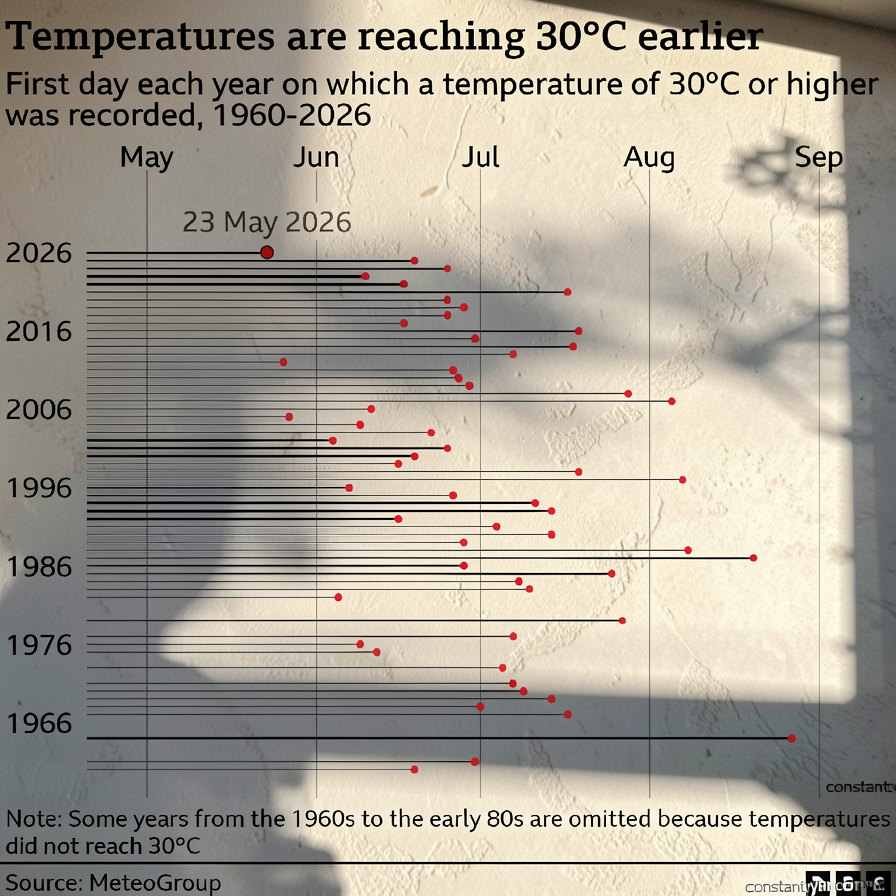
Temperature records compiled over decades show that the onset of extreme heat has been pulling forward by roughly four weeks. In the 1960s, the first day of the year reaching 30°C arrived, on average, around 13 July. In the 2020s, that threshold is now crossed around 19 June. The practical implication for schools is immediate: the weeks once reserved for revision and examinations now overlap with the peak of the thermal season.
This year’s June delivered one of the most intense heatwaves the UK has experienced, with up to seven consecutive days well above the official heatwave thresholds of 25–28°C. On 26 June, Lingwood in Norfolk recorded 38°C — the hottest June day ever measured in Britain. The Met Office issued a red extreme-heat warning at the end of the month, and the UK Health Security Agency activated multiple amber-level public-health alerts over the preceding weeks. July brought no relief; heatwave conditions persisted across most of the month, compounding the stress on already-strained school infrastructure.
Voices from the Ground
Parents have begun to organise around the issue. Andrea Bigger, a London mother, described her daughter’s previous experience of heat exhaustion at primary school, which ended in hospitalisation after the child overheated in a classroom. She characterised the national situation bluntly: the UK is “not ready or prepared” for the thermal conditions now becoming routine.
On the institutional side, the call to rethink the calendar has been growing louder. In February 2026, Sir Martyn Oliver, chief inspector at Ofsted, made the case publicly:
“It’s pretty hot usually in May, June and July, just at the point you’re asking children to sit down and take an exam… so I think there is a need to have a good old look at it [the school year].”
Steve Chalke, who founded Oasis Academy — a chain operating more than 50 schools across England — described the recent heatwaves as a “real inhibitor” to teaching, underscoring that the problem is not theoretical but operational, hitting lesson delivery week after week.
What the Science Projects Forward
Will Lang, chief meteorologist at the Met Office, framed the broader shift: the “de facto ‘hot season’ in the UK is lengthening, with increasing prevalence of hot weather — including heatwaves — in May and September in addition to the standard meteorological summer of June, July and August.” In other words, the window of dangerous heat is expanding at both ends of the traditional summer, compressing the already-vulnerable exam period from two directions.
A joint study by the Met Office and University College London modelled the educational cost of continued warming. Under a trajectory in which global average temperatures exceed 2°C above pre-industrial levels — a scenario many scientists consider likely on current emissions paths — the average UK pupil could lose an estimated 8.2 days of effective learning per year to extreme-heat disruptions. That figure represents not a single catastrophic event but the accumulated toll of repeated “heat days” on which classrooms become too warm for sustained concentration.
Research into classroom thermal comfort has identified 26°C as an upper boundary beyond which cognitive performance degrades measurably. Much of the UK’s school estate, particularly older Victorian and interwar buildings, was designed without assuming sustained indoor temperatures above that line. Retrofitting ventilation or cooling at scale would require investment on a scale the sector has not yet secured.
The Policy Question Ahead
Whether the answer lies in shifting the summer holiday earlier, staggering exam sittings, investing in building retrofits, or some combination of all three, the window for decision is narrowing. The data from this summer — record-breaking, unprecedented in duration and intensity — will not be an isolated anomaly. It is the first full expression of a pattern that the meteorological record shows is already entrenched. The school calendar, a structure inherited from an era of reliably mild British summers, now sits in direct conflict with the thermal reality of the coming decades. The question is no longer whether the calendar will need to change, but how quickly the system can adapt before the next exam season collides with the next heatwave.
Related Reading
Frequently Asked Questions
What is How a new era of heatwaves?
How a new era of heatwaves is the main topic of this guide. The article explains the context, practical details, and next steps readers should understand.
Why does How a new era of heatwaves matter?
How a new era of heatwaves matters because readers are looking for a useful answer, not just a short summary. Good content should match search intent and help them decide what to do next.
