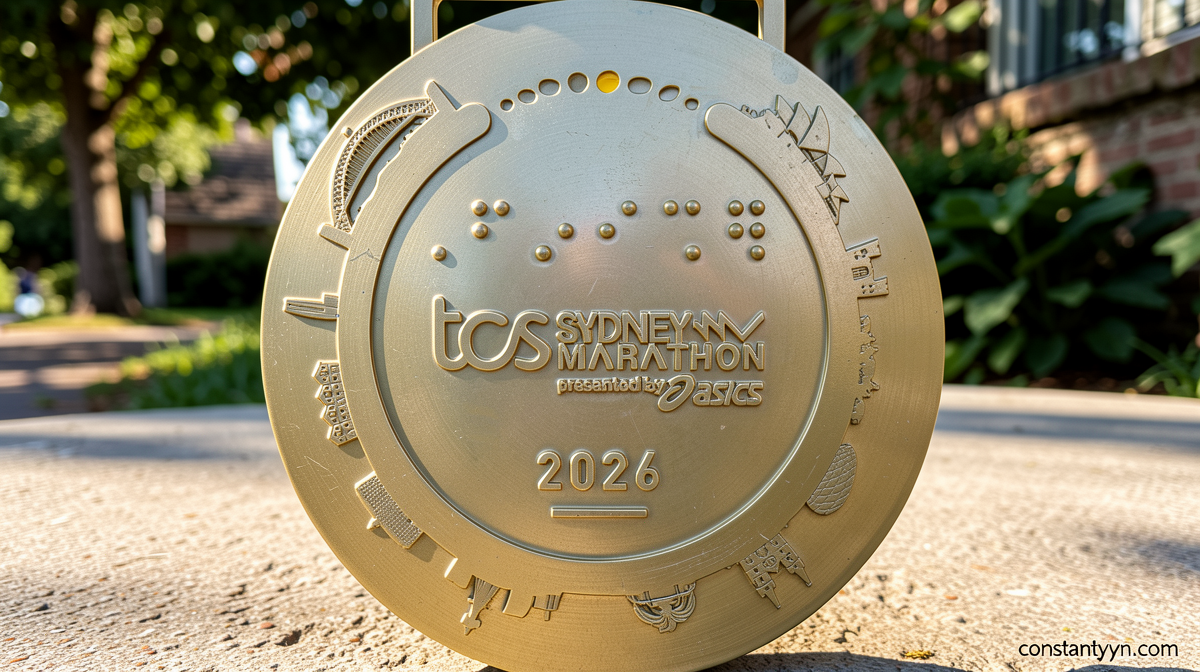
Wrong City, Wrong Stadium: Sydney Marathon’s 2026 Medal Sparks Design Controversy
Constantvpn.com – With fewer than seven days remaining before roughly 40,000 runners lace up for the Sydney Marathon on 30 August, organisers have found themselves at the centre of an unexpected design dispute. The participation medal unveiled for the 2026 edition of the event appears to depict Munich’s Allianz Arena rather than Sydney’s own Allianz Stadium — a landmark that sits directly along the 42.2-kilometre (26.2-mile) race route. The mix-up has drawn scrutiny from runners, spectators, and design observers alike, raising questions about the vetting process behind one of the world’s most high-profile marathon medals.
Two Arenas, One Confusing Name
The root of the confusion lies in a naming coincidence that spans two continents. Munich’s Allianz Arena, home of Bayern Munich and the German national team, is instantly recognisable by its exterior cladding of thousands of diamond-shaped inflatable cushions that glow red or white depending on which club is playing. Sydney’s Allianz Stadium, by contrast, presents a far more restrained profile: a comparatively flat façade interrupted by long, horizontal bronze fins that give the structure a sleek, aerodynamic silhouette. To anyone familiar with either venue, the distinction is unmistakable — yet the medal’s sculpted relief, positioned in the lower-right quadrant of the design, appears to replicate the Munich structure’s distinctive cushion geometry rather than the Sydney venue’s finned walls.
The Sydney Marathon course passes directly alongside Allianz Stadium, making the stadium a natural inclusion in any commemorative artwork celebrating the route. Its substitution with a German football ground, however, undermines the medal’s stated purpose of mapping the runner’s journey through the city.
What the Organisers Said
The controversy ignited after the event’s official social media channels released the 2026 medal artwork and invited the public to examine it closely. The accompanying caption read:
“Look closely and you’ll find the story of the course in the details.”
The post went on to describe the intended narrative of the design:
“A beautiful Sydney skyline brings the course to life, featuring the landmarks runners will experience along the way — starting with the Sydney Harbour Bridge and finishing at the world-famous Sydney Opera House.”
Those two landmarks — the Harbour Bridge and the Opera House — are indeed present in the artwork. The problem is the third major structure tucked into the composition’s lower-right corner, which bears the unmistakable visual signature of Munich’s arena rather than the Sydney venue the organisers clearly intended to honour.
The Other Face: First Nations Artwork
The medal is double-sided. Its reverse carries a gold-and-indigo geometric pattern created by First Nations artist Ambrose Killian, whose work draws on ancestral design traditions. Along the circular rim of that face, forty-two half-round notches are inscribed, each one corresponding to a single kilometre of the marathon distance, as organisers explained in their design notes. Killian, when contacted, confirmed he was responsible solely for the reverse-side artwork and had no involvement with the skyline relief on the front.
A Pattern of Precedent
Marathon and endurance-event organisers are not strangers to medal errors. Last year’s Great North Run in Newcastle produced a comparable fiasco when its commemorative pieces mistakenly featured Sunderland’s skyline and the River Wear — neither of which forms part of that event’s course. The recurrence of such mistakes across different continents and different events suggests a systemic gap in the quality-control pipeline between concept sketches, sculpted proofs, and final production runs.
Scale and Stakes
The Sydney Marathon is no minor local race. More than 120,000 ballot entries were received for the 30 August event, from which approximately 40,000 participants were ultimately selected. The field will include elite international athletes, charity fundraisers, first-timers, and seasoned marathoners who have logged hundreds of kilometres of training. For many, the medal is the tangible culmination of months of preparation — a keepsake they intend to display for years. A design that misidentifies the city’s own skyline diminishes that personal significance and, arguably, the event’s brand integrity.
Abbott Majors Context
Sydney was admitted as the seventh city in the Abbott World Marathon Majors series in 2024, joining London, Berlin, Boston, Chicago, New York, and Tokyo. Cape Town is scheduled to become the eighth member when it stages its inaugural major marathon next year. Within that elite grouping, where each city’s medal is scrutinised by a global running community and broadcast audiences, a visible design error carries outsized reputational weight. The Abbott Majors brand positions its member events as the pinnacle of marathon competition; a medal that confuses one city’s stadium with another’s sits uneasily alongside that positioning.
What Happens Next
Organisers have not yet issued a public statement addressing the stadium discrepancy. Whether the error will be corrected before production runs, acknowledged in a follow-up communication, or simply absorbed as an unfortunate quirk of the 2026 edition remains to be seen. For the runners who will cross the finish line beneath the Sydney Opera House on 30 August, the question is whether the object they receive in exchange for their effort will accurately celebrate the city they ran through — or one they never visited.
Related Reading
Frequently Asked Questions
What is Sydney Marathon medal mistakenly depicts Munich?
Sydney Marathon medal mistakenly depicts Munich is the main topic of this guide. The article explains the context, practical details, and next steps readers should understand.
Why does Sydney Marathon medal mistakenly depicts Munich matter?
Sydney Marathon medal mistakenly depicts Munich matters because readers are looking for a useful answer, not just a short summary. Good content should match search intent and help them decide what to do next.
