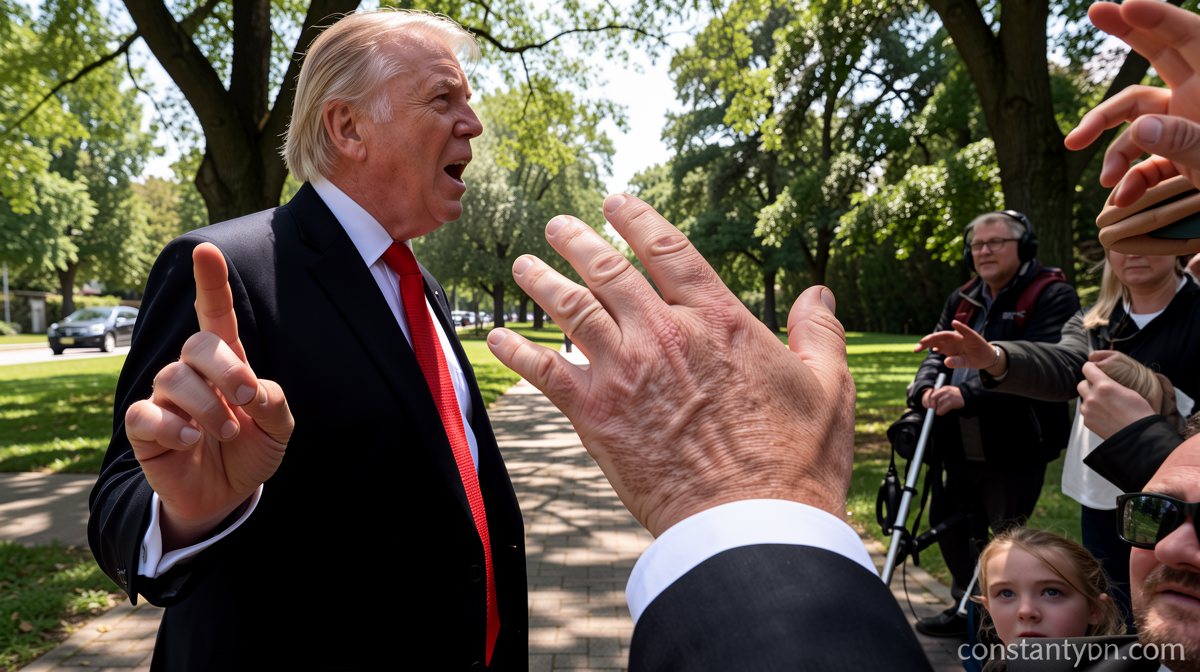
When Questions Become Threats: The Pattern Behind a President’s Press Outbursts
Constantvpn.com – Since taking office in January 2017, President Donald Trump has cultivated a reputation for volatile exchanges with members of the press corps. What began as occasional sharp remarks during campaign rallies evolved into a recurring pattern at official events: a reporter asks a question the president finds inconvenient, and within seconds the tone shifts from procedural to personal. The interruptions, the mocking, the dismissive hand gestures — these have become so predictable that political analysts now treat them as a recognizable genre of American political theater.
Yet beneath the spectacle lies a more pointed question. What exactly sets off these eruptions? Which topics, which phrasings, which reporters seem to cross an invisible line? Investigative reporting into the phenomenon has revealed that the triggers are neither random nor evenly distributed. They cluster around specific policy areas, specific lines of questioning, and — most notably — specific demographics among those asking.
The Questions That Cannot Be Asked
Reviewing the documented incidents reveals a consistent taxonomy of topics that reliably provoke a sharp response. Questions probing the president’s business dealings, his relationships with foreign leaders outside official channels, or the internal dynamics of his administration tend to land in a zone where the answer would require either candor or deflection. When a reporter pushes past the prepared talking point — asking for specifics, names, dates, or admissions — the exchange frequently escalates.
Equally predictable are questions touching on the president’s own legal entanglements, the conduct of allies and family members in business or political roles, and the mechanics of how executive power is being exercised in ways that depart from established norms. These are not abstract policy debates; they are accountability questions, and they appear to register as personal affronts rather than professional duties.
A Gendered Pattern
One of the most documented features of these outbursts is their disproportionate targeting of women. Female correspondents covering the White House have described a consistent experience: questions that would receive a measured answer from a male colleague instead draw an interruption, a sarcastic aside, or a full-blown rebuke. The phenomenon has been observed across multiple newsrooms and at events ranging from formal press briefings to informal hallway encounters.
The pattern is not merely anecdotal. Video recordings show the president addressing female reporters with a tone and volume markedly different from those directed at male colleagues asking substantively identical questions. In several widely circulated clips, a woman’s question is met with a raised voice, a pointed finger, or a cutting remark that ends the exchange before an answer is delivered. The cumulative effect, as described by the journalists themselves, is one of intimidation designed to narrow the range of questions deemed acceptable.
“Quiet, quiet, quiet!”
That exclamation — delivered with theatrical finality — has become shorthand for the phenomenon. It is not a request for order in a chaotic room. It is a unilateral termination of a question, a signal that the answer will not be given and that the reporter’s presence in the conversation is now unwelcome.
Why It Matters Beyond the Press Room
The significance of these exchanges extends well past the journalists involved. In a democratic system, the press corps functions as the institutional mechanism through which citizens learn what their government is doing and why. When that mechanism is subjected to repeated personal attacks, the chilling effect is not confined to the individuals present. Editors choose which questions to assign. Reporters self-censor topics they anticipate will provoke a scene. The range of public inquiry narrows, and the accountability function of the press weakens accordingly.
Predecessor presidents maintained varying degrees of warmth or coldness toward the press corps, but the institutional norm — however imperfectly observed — was that questions would be answered, or at least acknowledged, without the questioner being personally demeaned. The shift under the current administration represents a departure from that norm, one that has prompted commentary from press-freedom organizations, former White House correspondents, and scholars of executive-press relations.
The Broader Political Calculus
There is also a strategic dimension. By converting routine questions into public confrontations, the administration controls the narrative frame. A clip of a shouting match dominates social-media feeds far more effectively than a measured answer on trade policy or foreign affairs. The outburst becomes the story, and the substance of the question recedes into the background. Whether this is calculated or instinctive, the effect is the same: attention is redirected from the inquiry to the spectacle.
For the American public, the practical consequence is a thinner record. Questions that go unanswered because the questioner was silenced mid-sentence never enter the public transcript. The official record reflects only what was permitted to be completed. In that sense, every interrupted question is a small gap in the democratic ledger — a piece of information that citizens are owed but never receive.
The pattern continues. Each new event offers another data point, another clip, another instance in which the boundary between a professional question and a personal provocation is drawn by the person being asked, not by the person asking. Until that boundary shifts, the press corps will continue to navigate a landscape where the cost of asking the right question is measured not in time or effort, but in public humiliation.
Related Reading
Frequently Asked Questions
What is Quiet quiet quiet?
Quiet quiet quiet is the main topic of this guide. The article explains the context, practical details, and next steps readers should understand.
Why does Quiet quiet quiet matter?
Quiet quiet quiet matters because readers are looking for a useful answer, not just a short summary. Good content should match search intent and help them decide what to do next.
