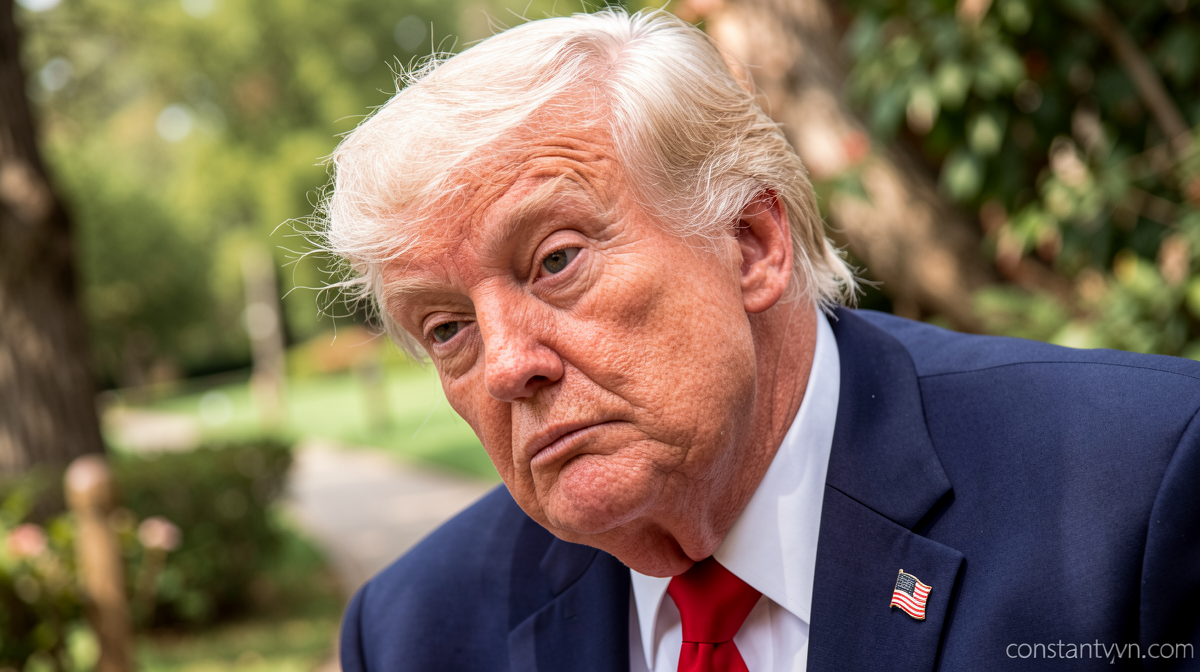
Washington’s Latest Gambit: An Economic Siege Aimed at Iran’s Trade Partners
Constantvpn.com – What began as a promise of rapid military dominance over Tehran has, nearly half a year later, calcified into a grinding stalemate. Neither a decisive battlefield outcome nor a negotiated ceasefire has materialised, and the diplomatic channels that once offered a sliver of hope have largely gone silent. Into that vacuum, President Donald Trump has now injected a new instrument of coercion: what he has labelled an “economic D-Day,” a sweeping campaign designed to impose “tremendous” financial penalties on any nation that continues to trade with, fund, or otherwise sustain the Iranian economy.
The logic is straightforward in theory. If direct military pressure cannot compel Tehran to capitulate, then strangling the external lifelines that keep its economy afloat might. The complication, however, is that Iran has been living under layers of Western sanctions for decades. Its leadership has repeatedly demonstrated both the political will and the institutional ingenuity to absorb severe economic shocks, reroute commerce through informal networks, and outlast the very measures meant to break it.
What Washington Has Signalled
The precise operational details of the new pressure campaign have not yet been published. Treasury Secretary Scott Bessent indicated that a formal briefing would follow on 24 August, at which point the mechanics of enforcement would be laid out. In the interim, however, his remarks on CNBC left little ambiguity about the administration’s posture toward third-party traders.
“You are either with us or against us. If you insist on doing business with [Iran], either transferring money, buying their oil or doing seaborne sea transfers, then the US Treasury and the US government… will put its full might and force toward enforcing against you.”
Vice-President JD Vance framed the initiative as a distinct escalation in the broader confrontation, calling economic coercion the “most effective” lever remaining in the American toolkit. Speaking on the Clay Travis and Buck Sexton programme, Vance characterised recent weeks as evidence that Tehran had absorbed more pressure than Washington had.
“They’re going to try to apply economic pressure to us, but what has been true over the last couple of weeks is that they felt a lot more pressure than we have. We’re going to keep that going because we think that’s the best way to ultimately achieve the final objective.”
Decades of Sanctions and the JCPOA Rupture
Any assessment of whether a fresh sanctions wave can achieve what predecessors could not must begin with history. The United States has maintained some form of economic restriction on Iran since shortly after the Islamic Republic was established in 1979. Those restrictions tightened dramatically in 2018, when the first Trump administration pulled Washington out of the Joint Comprehensive Plan of Action — the 2015 multilateral agreement in which Iran agreed to cap its uranium enrichment in exchange for phased relief from Western financial penalties. The JCPOA’s collapse removed the principal incentive structure that had kept Iran’s nuclear programme within negotiated limits, and it reset the economic calculus for every trading partner that had been courting Tehran’s oil and petrochemical exports.
In the present conflict, the administration has already deployed what it calls Operation Economic Fury, a two-track programme pairing Treasury-coordinated sanctions aimed at regime financial flows with a naval blockade of Iranian ports. The “economic D-Day” announcement appears to layer a third dimension onto that architecture: explicit, publicly signalled consequences for foreign governments and firms that continue to move goods, capital, or shipping services through or toward Iran.
Analysts Question the Strategy’s Coherence
Imran Bayoumi, a geostrategy specialist at the Atlantic Council in Washington and a former policy adviser within the US defence department, read the latest announcement less as a coherent new doctrine than as a symptom of frustration. In his assessment, the administration has exhausted its preferred military and diplomatic options without securing the outcome Trump publicly demanded, and is now reaching for economic instruments as a fallback.
“This is really a recognition that the US is almost stuck in this war. It’s another try at economic pressure.”
Bayoumi went further, arguing that neither a military end-state nor an economic end-state has been clearly articulated by the White House. Without a defined objective, he contended, the sanctions apparatus risks becoming a blunt instrument that punishes peripheral economies while leaving Tehran’s core decision-making calculus unchanged.
Michael Parker, who spent eight years inside the Office of Foreign Assets Control and now advises on sanctions architecture, offered a more technical reading. He suggested the new campaign is an attempt to widen what he called the “economic blast radius” of existing measures by explicitly targeting third-country actors whose economies depend on the US dollar but who continue to facilitate Iranian trade. Historically, Washington has relied on the implicit threat of secondary sanctions against foreign banks to secure voluntary compliance. Parker argued that the current approach would make that threat explicit and operational, reaching into any dollar-denominated transaction that also touches an Iranian counterparty.
“Thus far, the US has largely used the threat of these secondary sanctions against foreign financial institutions to encourage compliance with sanctions policy. But this is a lever that is sort of unexplored insofar as targeting anything touching the US dollar that is also touching Iran.”
Tehran’s Proven Capacity to Adapt
The central counter-argument to any new sanctions package is empirical: Iran has repeatedly found workarounds. Mohammed Hammouda, an export-control and sanctions manager at the London Stock Exchange, described a pattern in which Tehran deploys “shadow” tanker fleets to move crude oil outside sanctioned shipping lanes, and spins up new commercial entities that do not appear on US Treasury watch-lists. Each enforcement action, he noted, tends to generate a fresh set of intermediaries within weeks.
“You keep seeing new names popping up, because Iran is adapting really quickly. Whatever sanctions one does, they find a new road [around it].”
Hammouda emphasised that the visible architecture of sanctions — the lists, the regulations, the public designations — represents only the surface layer. The substantive enforcement work occurs behind the scenes, with teams in multiple jurisdictions attempting to trace funds, vessels, and corporate structures that are deliberately obscured. That asymmetry between the speed of Iranian adaptation and the slower tempo of multilateral enforcement is, in his view, the principal reason successive sanctions packages have failed to produce the political concessions Washington sought.
What Comes Next
The 24 August briefing will determine whether the administration’s rhetoric translates into enforceable mechanisms or remains a declaratory posture. For trading partners in Asia, Europe, and the Gulf, the stakes are immediate: continued engagement with Iranian oil, petrochemicals, and transit shipping now carries an explicit, named threat of Treasury action. For Tehran, the question is whether a further tightening of external pressure can finally compress the space within which its informal networks operate, or whether the regime will once again absorb the shock, reroute its commerce, and wait for the next administration to recalibrate its objectives.
Related Reading
Frequently Asked Questions
What is How much could Trump s economic?
How much could Trump s economic is the main topic of this guide. The article explains the context, practical details, and next steps readers should understand.
Why does How much could Trump s economic matter?
How much could Trump s economic matters because readers are looking for a useful answer, not just a short summary. Good content should match search intent and help them decide what to do next.
