Recovery Cranes Deployed as Lewes Derailment Site Faces Prolonged Closure
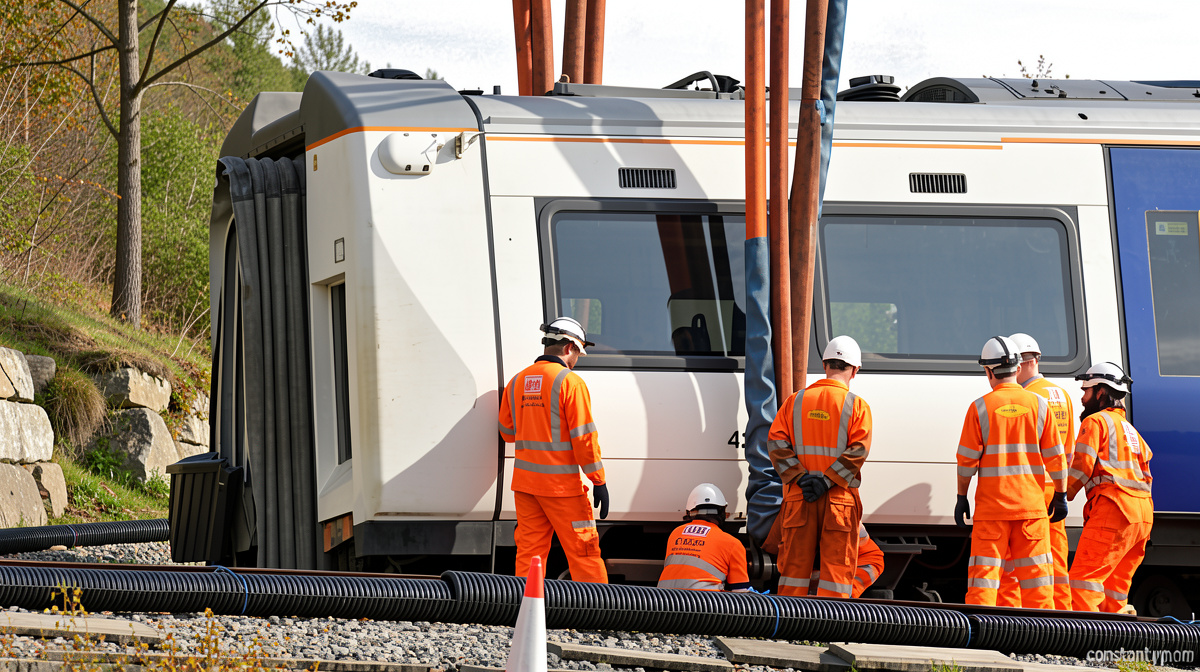
Constantvpn.com – Specialist cranes and heavy lifting machinery have been positioned along a stretch of railway near Lewes, East Sussex, as engineers work to extract the remaining carriages from a derailment that left 150 passengers stranded and 30 injured. The operation marks the most intensive phase of a multi-day recovery effort following the collapse of a Southern passenger service from London Victoria to Eastbourne, which left the tracks last Thursday at approximately 14:24 BST.
Two of the four carriages still resting at the accident site were lifted and relocated on Thursday, with the final two scheduled for removal on Friday. The work has required the construction of temporary foundations and platforms capable of supporting the weight of industrial cranes, a logistical undertaking complicated by the derailment’s proximity to the River Ouse and the surrounding residential area.
Track Defect at the Heart of the Investigation
The Rail Accident Investigation Branch (RAIB) has issued a preliminary finding identifying a defect in the track at the point where the train left the rails. Investigators are now digging into how that section of line was inspected and maintained in the weeks and months preceding the incident, the structural condition of the embankment beneath the track, and whether the sustained hot weather of the preceding days contributed to the failure.
Network Rail and Greater Thameslink Railway (GTR), the operator that runs Southern services, have confirmed they will review the RAIB’s recommendations once the full investigation concludes and will work to implement any corrective measures. The scope of the ongoing inquiry extends beyond the immediate mechanical cause, encompassing the condition of the rolling stock, the adequacy of the emergency response, and the environmental factors present at the time of the accident.
Passengers Describe a Terrifying Aftermath
Those aboard the service recalled a scene of confusion and heat as the train came to rest on its side. Passenger John May described how many travellers found themselves trapped inside the overturned carriages, unable to exit under their own power. While some managed to climb out, others waited in sweltering conditions until firefighters arrived with ladders to assist their evacuation.
Rob Bradley, a regular commuter from Eastbourne who was travelling with his daughter when the derailment occurred, spoke of the unsettling feel of the line long before the accident. He described the track as “jostly” and noted that it “does have some movement” on a routine basis.
“I never thought at all that you could end up in a derailment because of it. You think it’s a railway and there’s going to be some bumps along the way. I never thought about it leading to such an accident.”
Bradley’s account echoes a broader pattern of passenger complaints about ride quality on this corridor, a stretch of line that has long been associated with roughness due to its age and the engineering challenges of its alignment through the South Downs landscape.
Local Politician Raises Alarm Over Known Instability
James MacCleary, the Member of Parliament for Lewes, characterised the RAIB’s preliminary findings as “deeply concerning.” He noted that the reputation of the track between Haywards Heath and Lewes for excessive vibration was well established among local commuters and residents.
“It’s kind of well-known locally how bumpy that stretch of track is.”
MacCleary recalled seeing “people’s coffee flying around on tables and people struggling to type on laptops” during routine journeys, and said he had raised concerns with Southern on more than one occasion. His central frustration, he said, was that the issue had been flagged previously yet “we still ended up with a derailment.”
Reopening Timeline and Environmental Safeguards
The section of line between Haywards Heath and Lewes is expected to reopen on 1 September, a date that coincides with the end of the school summer holidays. John Whitehurst, chief executive of GTR, described getting the route operational before that deadline as “an absolute priority,” adding that his organisation was working closely with Network Rail “despite very challenging circumstances.”
Lucy McAuliffe, Network Rail’s Sussex route director, explained that the derailment’s location beside the River Ouse made reinstatement of the site “particularly complex.” She emphasised that the recovery was being conducted with careful attention to the surrounding ecology and to residents living in close proximity to the works.
“The recovery is being carried out with careful consideration for the area around the derailment site, ensuring the area’s ecology is protected and being mindful of residents living nearby.”
Before the line can carry passengers again, rigorous testing and inspections of the repaired track and embansment are planned. McAuliffe and Whitehurst issued a joint statement following the preliminary report reaffirming that Britain’s railway remains “one of the safest in the world,” while stressing the necessity of understanding precisely what went wrong and extracting lessons for the wider network.
For commuters on the Victoria-to-Eastbourne corridor, the closure represents a significant disruption to a route that serves thousands of daily travellers, including students, healthcare workers, and holidaymakers heading to the coast. The extended timeline for repairs, combined with the ongoing RAIB inquiry, means that full normality on this stretch of line will not return until at least the autumn term begins.
Related Reading
Frequently Asked Questions
What is Train derailment carriages moved amid track?
Train derailment carriages moved amid track is the main topic of this guide. The article explains the context, practical details, and next steps readers should understand.
Why does Train derailment carriages moved amid track matter?
Train derailment carriages moved amid track matters because readers are looking for a useful answer, not just a short summary. Good content should match search intent and help them decide what to do next.
