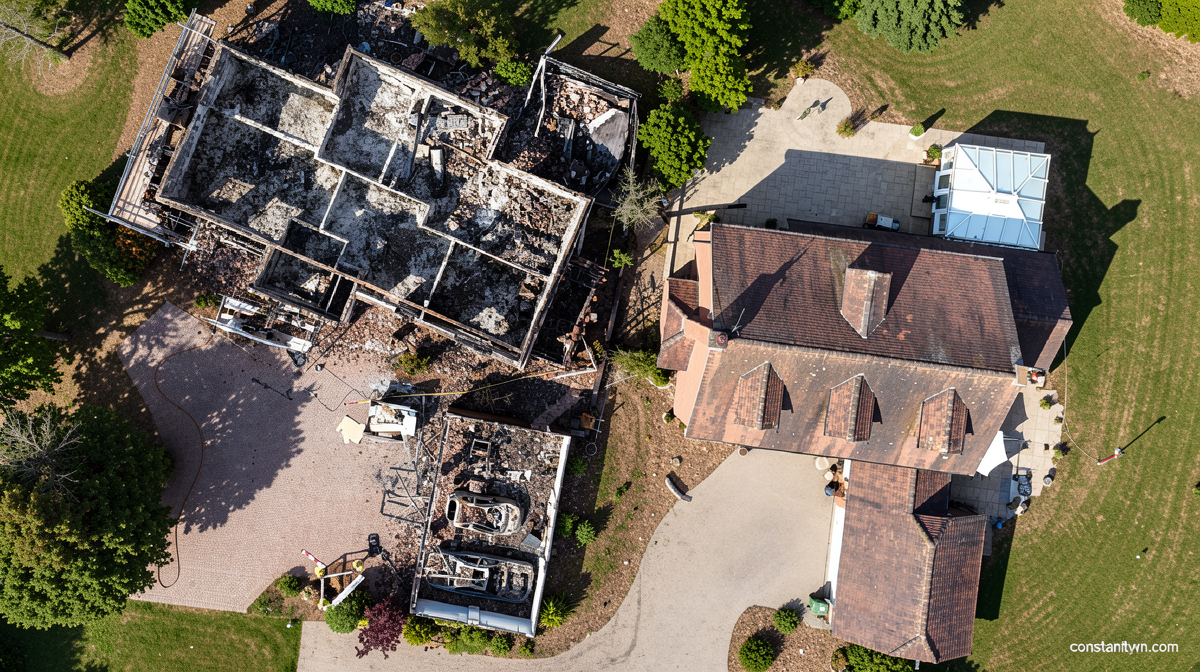
Stourbridge Fire: Why Neighbouring Houses Met Such Different Fates
Constantvpn.com – In the weeks following the devastating blaze that tore through five streets in Stourbridge, a question has echoed through the town: why did one house stand intact while the property directly beside it was reduced to a charred skeleton? Nineteen homes were completely destroyed, eighteen more suffered severe structural damage, and eight families were left staring at the hollowed-out shells of what had been their houses. The answer, fire safety experts explain, lies not in any single variable but in a tangled interplay of wind, radiant heat, ember dispersal, and the small differences in what surrounds each building.
The Human Cost of an Uneven Blaze
For residents like Pritpal Boyal, whose father-in-law’s house survived while relatives’ home nearby burned to the ground, the inconsistency felt almost random. Watching the aftermath from above, aerial photographs captured houses that appeared untouched sitting mere metres from structures flattened by flame.
“I was just amazed at how my father-in-law’s house was still standing. It was like a lottery of whether your house was going to survive or not.”
Boyal described the scene as terrifying and expressed deep sympathy for those who lost everything. Dozens of people were pulled from their homes as the fire spread, though the situation was not uniformly catastrophic. Dudley Council confirmed that of the 96 households evacuated during the incident, 85 families were subsequently cleared to return. An additional thirteen households whose properties sustained damage were also permitted to go back.
David Price, whose home on the opposite side of the road escaped the flames, said he remained bewildered by the outcome. Hanging baskets still dangled from his eaves while properties across the street had been consumed.
“When you see the devastation it’s literally skipped [our house]. There’s still hanging baskets here. I can’t work it out.”
Price attributed his survival to wind direction steering the flames away from his property, while acknowledging the horror felt for neighbours who lost everything.
“I’m devastated for them, I think it’s awful. It isn’t something you can just put right, is it?”
Loxie and Robin Williams returned to their Brunswick Gate home for the first time on Sunday after the fire, confronting the full scale of destruction surrounding their own intact property.
What Fire Science Says About Uneven Destruction
The stark contrast between adjacent properties is, according to Dr Tony Fogarty, a fire safety specialist based in Redditch, Worcestershire, entirely consistent with how fires actually behave. The popular image of a wildfire as a solid, advancing wall of flame is misleading, Fogarty explained.
“When fire is burning, it doesn’t move like a solid wall. Think a bit more like being a powerful hose in the wind. Some areas get force and others don’t.”
Wind direction and speed can shift the trajectory of a blaze within seconds, sending heat and flame toward one garden while sparing the next. Burning embers, carried ahead of the main fire front, can ignite new fuel sources at a distance, meaning a house need not sit directly in the fire’s path to face serious risk.
The Role of Firebreaks and Surrounding Structures
One of the most significant determinants of whether a building survives, Fogarty explained, is what physically sits between the fire and that building. A property lined with wooden fences, garden sheds, decking, and accumulated dry vegetation presents a continuous fuel corridor. The neighbouring house, by contrast, might have open patios, cleared borders, and no outbuildings adjacent to the main structure.
“You might have one property which may have fences, shed, decking, loads of dried vegetation. The house next door may have patios and may not have any sheds next to the building, and then essentially that forms a firebreak and can initially stop that fire in its tracks as it moves up the garden.”
That single difference in garden layout can be the dividing line between total loss and survival, Fogarty said, and it helps explain why damage patterns look so erratic even between properties separated by only a few metres.
Radiant Heat: Damage Without Direct Flame Contact
Another mechanism often overlooked by residents is radiant heat. A fire generates intense thermal radiation that can damage or ignite materials even when visible flames have not physically reached a structure. Fogarty stressed that the heat alone, projected outward from the blaze, can engulf anything in its path.
“It’s not only the flames that cause fire itself on to the properties, you’ve [also] got what we call radiant heat. The flames do not actually have to touch the property itself… the heat that it creates will actually automatically engulf anything that’s in its path.”
This explains why some homes in Stourbridge sustained severe internal damage — melted wiring, scorched interiors, compromised structural elements — even though exterior photographs might suggest the flames never directly lapped the walls.
Dry Conditions Amplify Every Risk
Fogarty noted that the risk multiplies dramatically when vegetation and stored materials are exceptionally dry. In conditions where everything is “tinder dry,” a wind behind the fire, and a single ignition source present, the spread of flame can outpace what residents expect or recognise.
“Everything is tinder dry and when you’ve got a wind behind that, and we’ve got a source of ignition, it will spread beyond what people could even recognise.”
In such circumstances, even relatively small ignition sources — a spark, a pilot light, a discarded cigarette — can trigger a cascade that moves faster than anyone nearby can react. The Stourbridge fire, which consumed nineteen properties outright and severely damaged eighteen more across five streets, illustrates how quickly that cascade can overwhelm a residential area when conditions align.
For the families now facing the task of rebuilding or relocating, the scientific explanation offers little comfort. The unevenness of the damage, while explicable in principle, does not make the loss any less total for those who watched their homes disappear while the house next door still held its shape.
Related Reading
Frequently Asked Questions
What is How did some houses survive the Stourbridge?
How did some houses survive the Stourbridge is the main topic of this guide. The article explains the context, practical details, and next steps readers should understand.
Why does How did some houses survive the Stourbridge matter?
How did some houses survive the Stourbridge matters because readers are looking for a useful answer, not just a short summary. Good content should match search intent and help them decide what to do next.
