Root’s Quiet Authority Steers England to a Day-One Sweep at Headingley
Constantvpn.com – England’s new chapter under Joe Root began with a statement of intent: Pakistan were bowled out for 171 on the opening day of their first Test at Headingley, a score that signalled the old turbulence of recent seasons had been left firmly behind. Root, now 35 and back in the captaincy for a second spell after Ben Stokes stepped aside, had already claimed the toss before the first over was bowled. By the time the game was five balls old, the architecture of his leadership was visible — measured, collaborative, and pointedly unlike the high-octane style of his predecessor.
A Partnership Written in Yorkshire
The most telling image of the day came when Root walked off the field for the first time in his reinstated role, Harry Brook’s arm draped over his shoulder. The two Yorkshiremen — the only candidates England considered when Stokes vacated the captaincy — displayed no trace of rivalry. Brook, who had been passed over in favour of his friend and teammate, showed no bitterness. Root, who might have been tempted to assert dominance early, instead deferred to Brook’s tactical instincts throughout the session.
That deference was most apparent when Pakistan’s number three, Shan Masood, probed at the stumps. Brook, who has demonstrated sharp tactical acumen in his own white-ball captaincy, recommended reinforcing the gully region. Root, whose first spell in charge drew criticism for a perceived lack of on-field feel, agreed without hesitation. Yet the same captainship showed a ruthless streak moments later when Jofra Archer was pulled from the attack after two wayward overs with the new ball. Decisions were made quickly, then executed without drama.
Mid-Off: A Different Kind of Command
Root positioned himself at mid-off rather than the slips, a tactical choice with clear lineage. Both Stokes and former skipper Michael Vaughan — a figure who shaped Root’s early career through their shared Sheffield club roots — had captained from that vantage point. The move allows the 35-year-old to keep his ear close to his bowlers while ensuring the ball is always returned through him before the next delivery. Nothing happens until Root releases the ball.
The positioning also freed him from the reflexive catch-taking that defined his earlier career. Root holds a joint-record 218 Test catches, more than two-thirds of which came from the slips. Standing at mid-off, with his two young children watching from the stands, he could observe the broader picture and control tempo without becoming a passive fielder.
“I might not be as dynamic as Ben but we’ll see if we can make it work,” Root said on Tuesday.
That self-awareness extended to his pre-match remarks, where he identified the central challenge of his second stint:
“One of the big challenges is not trying to be Ben Stokes.”
Stokes had been a hands-on skipper, constantly chatting, encouraging, and intervening between deliveries. Root’s approach was markedly quieter. Overs from his pace bowlers passed with minimal verbal exchange — a word before the first ball, another after the sixth. The captain observed, adjusted, and stepped back.
Robinson’s Redemption Arc
The day’s standout performance belonged to Ollie Robinson, who returned 5-51 with accuracy and relentless variation. Robinson, 32 and the next-oldest member of the squad after Root, had been discarded under Stokes and former coach Brendon McCullum amid frustrations over his attitude and fitness. His average pace of 78.4 mph at Headingley belied any suggestion of diminished capability.
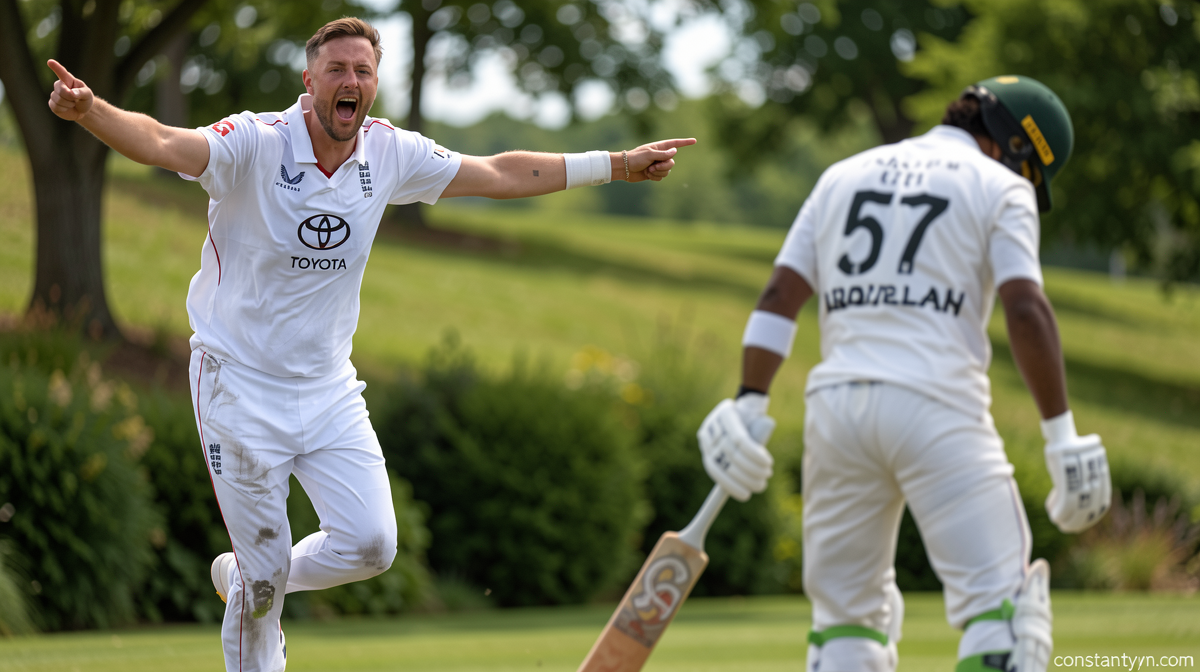
After pinning Azan Awais with his first ball, Robinson probed Masood’s outside edge from around the wicket before switching his angle in the third over. An inswinger found Masood plumb lbw, and Root celebrated with both arms raised high — a flash of the child-like enthusiasm from his early England days.
“He was good at just telling me he was moving the field and then to carry on bowling the same way,” Robinson said of Root’s minimal intervention. “Between the four bowlers, Joe and Harry we were discussing plans, discussing what was working. Brooky is always great on the field. He is the go-between guy and, standing at slip, can see different things.”
Robinson’s journey under Root has been marked by two painful memories. He made his debut in the first Test against New Zealand at Lord’s in 2021, a match England squandered by turning down a chase of 273. He was last man out in Hobart at the tail end of Root’s second Ashes defeat in 2021-22. Both losses sat within a run of just one win in 17 Tests at the close of Root’s first tenure — the record that had haunted his captaincy. Robinson’s immaculate day at Headingley offered a sharp counter-narrative.
What Remains
The afternoon was not without blemish. Imam-ul-Haq and Abdullah Shafique stitched together a 91-run partnership that drew the crowd’s attention away from England’s bowlers, and the pace quartet of Robinson, Archer, Gus Atkinson, and Josh Tongue still carries the rawness of a group not yet fully settled. Archer never located his rhythm; Atkinson and Tongue required time to find their groove.
Yet the structural foundations were laid. Root’s quiet authority, Brook’s tactical bridge role, and Robinson’s restored confidence formed a coherent unit on day one. Vaughan, who has urged England to commit fully ahead of a demanding 12-month schedule, would have noted that the captain’s approach — collaborative, restrained, and built around trusted lieutenants — offered a sustainable model for the long season ahead. England’s new era at Headingley began not with a shout, but with a controlled, collective exhale.
Related Reading
Frequently Asked Questions
What is How Root brought welcome calm on return?
How Root brought welcome calm on return is the main topic of this guide. The article explains the context, practical details, and next steps readers should understand.
Why does How Root brought welcome calm on return matter?
How Root brought welcome calm on return matters because readers are looking for a useful answer, not just a short summary. Good content should match search intent and help them decide what to do next.
