Twin Wildfires Claim Two Lives on Salamina as Evacuations Sweep the Island
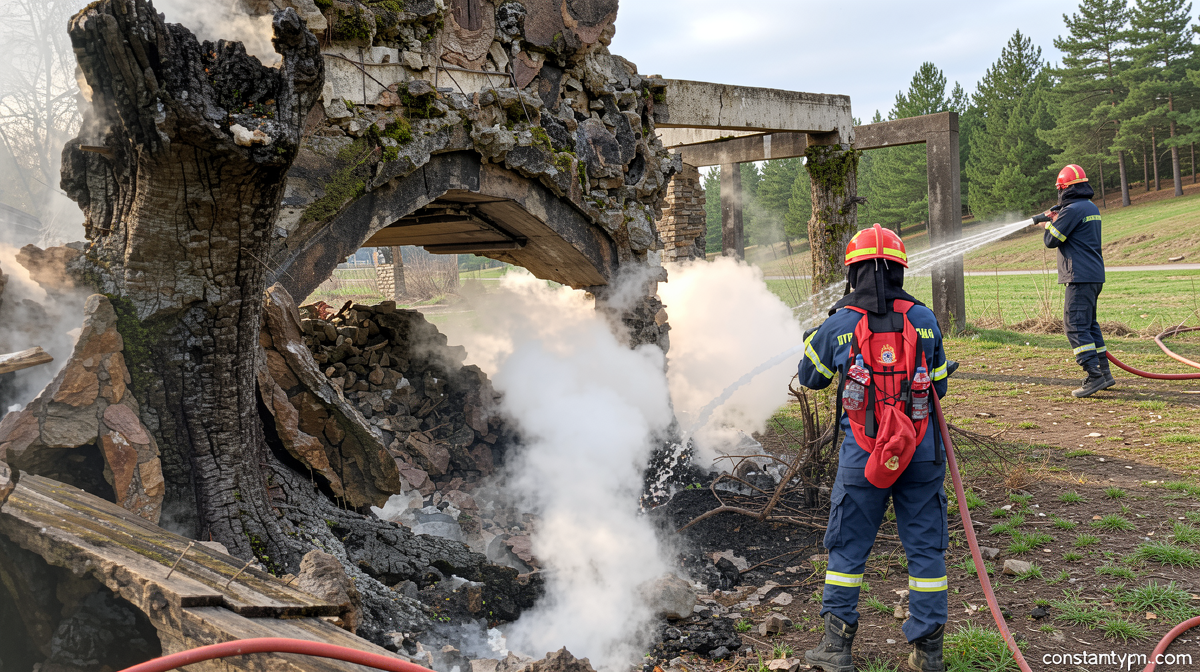
Constantvpn.com – A pair of near-simultaneous blazes tore through the Greek island of Salamina on Sunday afternoon, killing two residents and forcing hundreds of islanders to flee by sea. The twin fires, ignited within roughly twenty minutes of each other under conditions of extreme wind, prompted one of the largest coordinated emergency responses ever mounted on the island, which sits barely a few kilometres west of Athens and is home to approximately 37,000 people, a significant share of whom are elderly.
Authorities confirmed that the two victims were discovered at the scene of the first blaze, which erupted in a wooded residential zone in the southern settlement of Peristeria. The island’s mayor told local media that the deceased were believed to have been a couple. Fire official Vasilios Vathrakoyannis confirmed in a public statement that crews arriving at the Peristeria site located the two bodies.
How the twin blazes unfolded
The initial ignition was logged at 14:40 local time (11:40 GMT) along the island’s southern coastline. Strong winds drove the flames outward with alarming speed, turning what began as a contained forest fire into a fast-moving front within minutes. Approximately twenty minutes later, a second fire broke out in the eastern town of Selinia. Investigators had not yet determined the cause of either blaze as of Sunday evening.
The proximity of the two fires created an acute tactical problem: if both fronts advanced toward the island’s central mountain ridge, they risked merging into a single, far larger conflagration. Salamina Deputy Mayor Thodoris Zannis explained that the deployment strategy was specifically designed to prevent the two fires from crossing that ridge and coalescing.
Scale of the emergency response
Roughly 200 firefighters were committed to the operation, supported by a fleet of aircraft, fifty fire engines, water tankers, and heavy construction machinery used to cut firebreaks. Five patrol boats and several private vessels were dispatched to the surrounding waters to assist with evacuation and perimeter security. Two coast guard vessels and one fire-department ship were scheduled to remain stationed in the area through the following days for surveillance and backup support.
By Sunday evening, Greek media indicated that one of the two fires had been brought under control and that associated evacuations were complete. The Selinia blaze, meanwhile, was described as having “no active front,” meaning its spread had effectively halted. Nevertheless, crews continued to work scattered hotspots in the Peristeria area well into the night.
Injuries and evacuations
Greek Health Minister Adonis Georgiades, posting on the social platform X, stated that at least ten additional people sustained burns or displayed symptoms consistent with smoke inhalation. Five of those individuals were transported for treatment at local medical facilities.
Approximately 500 residents departed the island by sea during the course of the day. Given Salamina’s demographic profile — a substantial elderly population with limited mobility — evacuation logistics were a central concern for island officials throughout the afternoon.
A scorched continent: Europe’s wildfire weekend
The Salamina fires did not occur in isolation. Across western Europe, firefighters were battling multiple large-scale blazes over the same weekend. In Belgium, crews entered a third consecutive day of operations in the Hautes Fagnes, the country’s largest nature reserve, where a wildfire described as the biggest in the nation’s recent history had more than doubled its footprint within a single 24-hour window.
In Croatia, a coastal wildfire that tore through the shoreline overnight on Friday killed at least one person and injured dozens. Around 1,200 residents and tourists were evacuated. Croatia’s fire chief, Slavko Tucakovic, characterised the event as
“one of the worst” blazes in the country’s history.
The European Union’s climate-monitoring agency, Copernicus, confirmed that western Europe had just experienced its hottest June-to-July period on record, a finding that underscores the growing frequency and intensity of fire-weather episodes across the continent. For island communities like Salamina, where escape routes are limited to a handful of sea crossings and where vegetation covers much of the terrain, each successive heatwave season raises the stakes for preparedness, early detection, and rapid evacuation capacity.
What happens next
With the primary fronts contained or extinguished, attention shifts to mopping out residual hotspots, investigating the ignition causes, and assessing structural damage in the affected residential zones of Peristeria and Selinia. The continued presence of coast guard and fire-department vessels signals that authorities anticipate a prolonged monitoring period, particularly given the island’s wind patterns and the dry conditions expected to persist through the coming days.
Related Reading
Frequently Asked Questions
What is Two dead and hundreds evacuated after?
Two dead and hundreds evacuated after is the main topic of this guide. The article explains the context, practical details, and next steps readers should understand.
Why does Two dead and hundreds evacuated after matter?
Two dead and hundreds evacuated after matters because readers are looking for a useful answer, not just a short summary. Good content should match search intent and help them decide what to do next.
