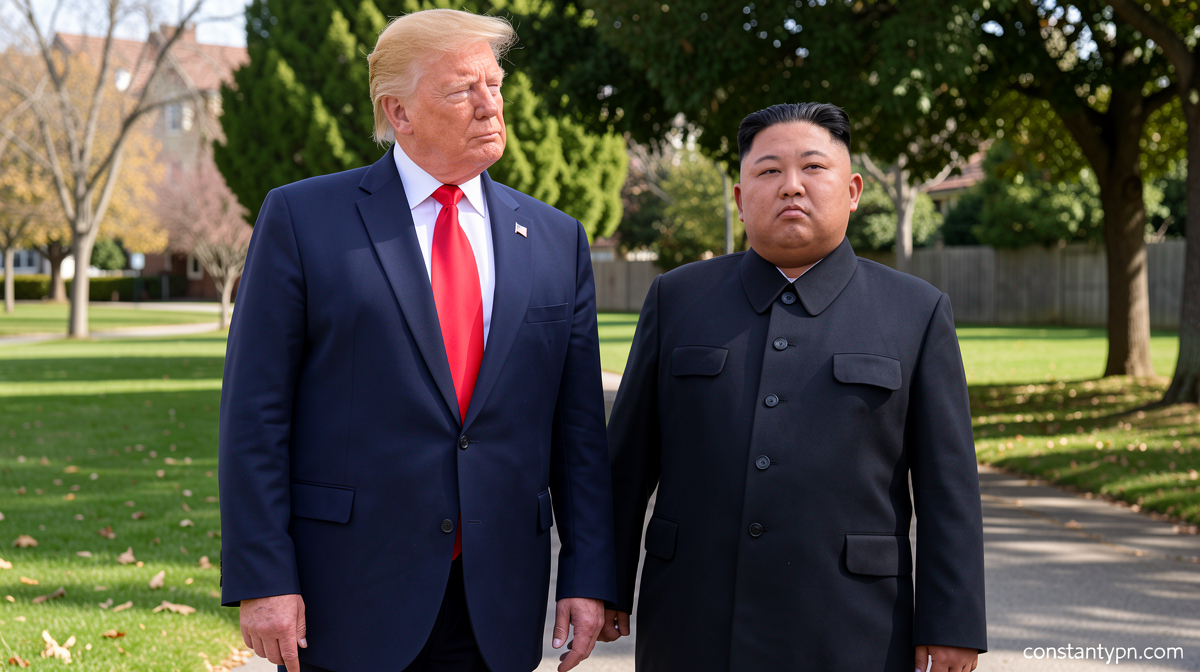
Trump Says US to Scale Back Korea Drills
Constantvpn.com – Trump says US to scale back its annual joint military exercises with South Korea, a decision announced via Truth Social on a Sunday just hours before the two nations were set to launch their yearly training cycle. President Donald Trump tied the move to two grievances: his claimed “very good relationship” with Kim Jong Un, and what he framed as Seoul’s refusal to join American operations against Iran. The timing left virtually no window for diplomatic recalibration before the drills were already underway.
The Ulchi Freedom Shield exercise — an 11-day combined operation drawing roughly 18,000 South Korean troops — was scheduled to begin the following Monday. Trump acknowledged the logistical reality, writing that it was “too late to cancel” at that point, yet his language made clear he intended the coming weeks to mark a structural break in how the two militaries operate together.
“These exercises are not only costly, with much of these costs paid for for the United States of America (as usual!), but send a signal that is totally inappropriate and hostile.”
Seoul’s Cautious Response and Pyongyang’s Silence
South Korea’s government confirmed the drills would proceed “as scheduled,” a formulation that accepted the immediate reality while quietly rejecting the premise that the exercises needed curtailment. No further elaboration accompanied the statement, and the tone suggested a government managing domestic expectations while avoiding a public confrontation with its principal security guarantor.
North Korea had not issued any comment on the announcement as of the time of writing. That silence came against a backdrop of heightened military activity: Pyongyang had carried out ballistic missile tests earlier in the month, actions that violate United Nations resolutions governing its nuclear programme. Within days, South Korea, the United States, and Japan detected a second such launch, underscoring how rapidly the northern regime continues to expand its missile capabilities.
The Iran Factor and Broader Allied Friction
Underlying the exercise dispute was a deeper question about burden-sharing in America’s current conflict with Iran. Trump made explicit that he had asked South Korea’s president whether Seoul wished to join what he called the “Denuclearization of the Islamic Republic of Iran,” and that the answer was a flat refusal.
“While somewhat unrelated (?), I recently asked the President of South Korea if they would like to join us in the Denuclearization of the Islamic Republic of Iran, and they said, ‘No thanks!’”
The parenthetical question mark and the quoted “No thanks!” carried an unmistakable tone of personal slight. The post appeared designed not merely to explain a military decision but to register displeasure with Seoul for withholding direct military or logistical support in the Iran campaign. That frustration extended beyond Korea: in recent weeks the president had voiced similar irritation toward Japan, France, and the United Kingdom over what he characterised as their hesitance to commit resources to the conflict.
What the Exercises Actually Involve
Ulchi Freedom Shield is the largest combined training event on the peninsula, drawing tens of thousands of personnel from both sides. Senior US and South Korean military leaders held a joint press conference the prior week confirming that the upcoming iteration would be comparable in scale to prior editions. They also addressed a specific operational concern: North Korea’s deployment of troops to support Russia’s war in Ukraine. US military spokesperson Ryan Donald stated that “our training accounts for that threat,” referring to the prospect of experienced North Korean soldiers returning to the peninsula with combat experience gained on the Eastern European front.
Approximately 28,500 American service members remain stationed across South Korea, making the peninsula one of the largest peacetime US military footprints outside the continental United States. Any perceived reduction in joint readiness therefore carries implications well beyond the two Koreas, touching on deterrence calculations across the broader Indo-Pacific.
FAQ
Will the Ulchi Freedom Shield drills actually be cancelled?
No. Trump acknowledged it was “too late to cancel” the current iteration, and South Korea confirmed the exercises would proceed as scheduled. However, his language signalled intent to substantially reduce the scale and frequency of future joint exercises.
Why did Trump link the exercise decision to the Iran conflict?
Trump stated he had asked South Korea’s president to join US operations aimed at the “Denuclearization of the Islamic Republic of Iran” and was told “No thanks.” He framed the exercise reduction partly as a response to that refusal, alongside his stated desire to avoid sending a “hostile” signal to North Korea.
How many US troops are stationed in South Korea?
Roughly 28,500 American service members are based across South Korea, making it one of the largest peacetime US military deployments outside the continental United States. Any shift in joint training posture therefore has implications for deterrence across the wider Indo-Pacific region.
