‘We must finish the job’: despite living on the frontline, northern Israelis try to maintain normality
‘We must finish the job’: despite living on the frontline, northern Israelis try to maintain normality
On Thursday morning, the main street of Metula was a hub of quiet resolve. Everyone present acknowledged the previous night’s “difficult” ordeal, as the warning sirens had ceased just hours prior. Military authorities confirmed no further waves of rocket and drone attacks were imminent from Hezbollah, the Lebanon-based militant Islamist group, and its ally, Iran. Yet, the calm remained tenuous. Warplanes swept low overhead, and the rhythmic thud of missile interceptions echoed frequently across the northernmost Israeli town.
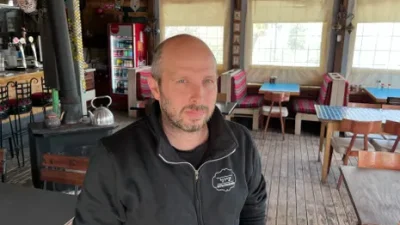
Residents gathered in the Bela café, a modest establishment in the heart of Metula, as the sound of Israeli artillery rumbled in the distance. Miry Menashe, 41, co-owner of the café, insisted on keeping it open. “The people of Metula don’t run away from rockets,” she said. “We want to preserve a sliver of normalcy for the residents, our soldiers, and ourselves. They come often now, so we give them a place to unwind, grab a drink, or enjoy a meal. That’s how we keep life moving forward,” Menashe added.
“Last night was tough. The last days have been the toughest. It was very bad. There is usually a break afterwards… then in the evening it starts again. Now we are drinking coffee in the sun,” said Shragan Shatil, 77, who has lived in Metula for 29 years. He visited the café with neighbors, reflecting on the war that had shuttered schools, offices, and businesses across Israel. “This conflict will end only when Mr Trump decides,” he remarked. “Even then, Israel may continue its campaign against Hezbollah alone.”
Israeli military officials reported that the overnight assault by Hezbollah involved approximately 200 rockets and missiles, alongside 20 drones. Notably, the barrage coincided with Iranian missile strikes for the first time. While no fatalities were recorded from the attacks, they caused significant property damage. To date, 12 Israelis have been killed by Iranian missiles in the war, with hundreds sustaining injuries.
Hezbollah’s operation, named “Operation Chewed Wheat”—a reference to a Quranic verse depicting enemies reduced to a state of vulnerability—marked a sharp escalation. The group, once thought weakened by nearly two years of Israeli airstrikes, now appears more aggressive. In response, Israeli warplanes swiftly targeted Lebanon, striking southern regions and Beirut’s suburbs. The offensive claimed at least 634 lives on its opening day, with 1,586 injured, and has displaced nearly a million people. The potential for further escalation, including a larger ground invasion, looms as a growing concern.
Yaakov Selavan, deputy mayor of the Golan regional council, voiced the collective sentiment of northern Israelis. “Residents expect the government and military to eliminate Hezbollah entirely,” he said. “They should advance as far north as the Litani River, 20 miles into Lebanon.” Many in the region share this view, having endured constant cross-border clashes and three rounds of direct confrontations with Iran, which has long seen Hezbollah as a proxy to challenge Israel’s existence.
For Daniel Dorfman, 43, the recent reopening of his Metula restaurant was a small victory amid the chaos. He opened his doors just days before Israel and the U.S. launched their campaign against Iran, 13 days prior. “We’ve learned that Hezbollah must be disarmed,” Dorfman stated. “The Lebanese government lacks the authority to do so. Iran is the head of the octopus, the main driver of Middle Eastern terrorism. If someone wants to destroy you, you have to strike at the source—like cutting off the octopus’s head,” he explained, echoing senior Israeli officials’ rhetoric.
