
A Century-Long Oil Concession: Washington Locks In Venezuela’s Hydrocarbon Future
Constantvpn.com – In a move that has split opinion across the Western Hemisphere and ignited fierce debate inside Venezuela itself, the United States and the interim government of Caracas have formalized a sweeping energy pact granting American-led operators control over a vast swath of Venezuelan crude. The agreement, signed in the Venezuelan capital on Wednesday, hands a US-backed enterprise 100-year concessions across 17 oilfields — a portfolio representing roughly 65 billion barrels of crude oil, or more than one-fifth of the nation’s proven reserves.
The deal crystallizes a strategy that Washington laid bare from the moment elite American forces stormed Nicolás Maduro’s compound in January and forcibly removed him from power. President Donald Trump declared at the time that the United States would effectively “run” Venezuela and oversee the marketing of its oil for the foreseeable future. Wednesday’s signing represents the operational endpoint of that stated objective.
Terms That Draw Sharp Lines
A White House fact sheet released on Tuesday outlined the structural mechanics of the arrangement. The US government will operate in tandem with North American Blue Energy Partners (Nabep), currently the second-largest private oil producer in Venezuela behind Chevron. Perhaps the most striking provision: Washington retains veto power over every appointment to Nabep’s board of directors, and a majority of that board must consist of US citizens.
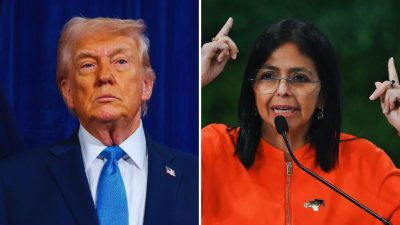
Interim President Delcy Rodríguez framed the pact as transformative for her country, projecting $100 billion (£74 billion) in fresh investment and over $200 billion in cumulative tax receipts. Trump, for his part, labeled it
“the biggest oil deal in world history.”
Rodríguez called the agreement
“historic.”
Strategic Calculus Beyond the Barrel
The timing is not accidental. With the ongoing US military confrontation with Iran pushing pump prices higher, a meaningful increase in crude output outside the Middle East carries direct implications for Western Hemisphere consumers. Secretary of the Interior Doug Burgum told Fox Business that the pact is
“shifting the geopolitical centre of the global energy markets”
away from what he termed the
“choke points in the Middle East”
and back toward the Americas. The White House has gone further, describing the arrangement as having
“re-established the Monroe Doctrine”
— the 19th-century doctrine of hemispheric dominance — while
“purging foreign malign influence from our backyard and ensuring American dominance in our hemisphere is never again questioned.”
Critics Call It Colonialism in Modern Dress
Not everyone in Washington’s orbit shares the enthusiasm. Elliott Abrams, who served as Trump’s former special representative on Venezuela and Iran, dismissed the arrangement bluntly:
“This is a terrible deal. [Rodríguez] has given away 20% of the national patrimony for nothing.”
He added that he believed Rodríguez was
“simply complying with the demands she’s getting from Washington.”
Abrams acknowledged a strategic logic to the partnership while Gulf supply chains remain unreliable, yet he characterized the one-sided terms as
“a kind of fever dream of what colonialism looks like.”
The Timeline Problem
Trump has publicly asserted that the concession will begin generating profit within two to three years. Energy-sector specialists push back hard on that estimate. Luis Pacheco, a researcher at the Baker Institute for Global Markets at Rice University in Houston, told BBC Mundo that Venezuela would need to invest approximately $100 billion over an eight-year horizon merely to restore output to levels last seen three decades ago. He raised a pointed question about governance:
“It’s important to know who will manage those resources and for what purpose. Are they going to put the same people in charge of managing that money who already squandered the biggest oil boom of the century?”
The reference is to decades of mismanagement under which Venezuela’s once-mighty state oil company PDVSA saw production collapse from roughly 3.5 million barrels per day in the early 1990s to well under one million today.
Domestic Political Fallout
Inside Venezuela, the opposition views the pact through a lens of deep suspicion. Many opponents of the former Maduro government accuse Rodríguez of presiding over essentially the same apparatus, merely with a different nameplate. The Trump administration had spent months branding Maduro’s circle a corrupt drug cartel and had massed the largest naval armada in the modern era around the country’s shores. The speed and ease with which Washington has now pivoted to collaborating with Maduro’s former vice-president strikes many Venezuelans as a betrayal of stated principles.
María Corina Machado, the Nobel Peace Prize laureate and leading presidential candidate, has become a focal point of that discontent. She personally presented Trump with her Nobel medal in a gesture of diplomatic overture, yet her supporters argue the oil concession undermines the democratic transition she champions. Whether Machado will formally endorse, contest, or distance herself from the arrangement remains an open question as the political landscape in Caracas continues to shift.
For ordinary Venezuelans who have endured years of fuel shortages, blackouts, and hyperinflation, the promise of $200 billion in future tax revenue sounds like salvation. But the gap between that projection and the operational reality of aging pipelines, depleted wells, and a workforce hollowed out by emigration remains vast — and the next decade will determine whether the concession delivers prosperity or simply entrenches a new form of external control over the nation’s most valuable asset.
Related Reading
Frequently Asked Questions
What is Remarkable US oil deal puzzles analysts?
Remarkable US oil deal puzzles analysts is the main topic of this guide. The article explains the context, practical details, and next steps readers should understand.
Why does Remarkable US oil deal puzzles analysts matter?
Remarkable US oil deal puzzles analysts matters because readers are looking for a useful answer, not just a short summary. Good content should match search intent and help them decide what to do next.